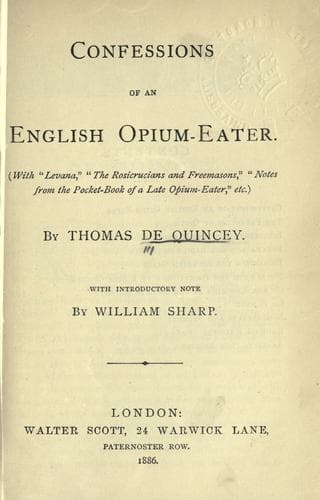
Note Book of an English Opium-EaterDe Quincey, Thomas
Philosophy
Note Book of an English Opium-Eater
De Quincey, Thomas
Opium abuse -- England
On the whole, if Walking Stewart were at all crazy, he was so in a way
which did not affect his natural genius and eloquence--but rather exalted
them. The old maxim, indeed, that 'Great wits to madness sure are near
allied,' the maxim of Dryden and the popular maxim, I have heard disputed
by Mr. Coleridge and Mr. Wordsworth, who maintain that mad people are the
dullest and most wearisome of all people. As a body, I believe they are
so. But I must dissent from the authority of Messrs. Coleridge and
Wordsworth so far as to distinguish. Where madness is connected, as it
often is, with some miserable derangement of the stomach, liver, &c. and
attacks the principle of pleasurable life, which is manifestly seated in
the central organs of the body (i.e. in the stomach and the apparatus
connected with it), there it cannot but lead to perpetual suffering and
distraction of thought; and there the patient will be often tedious and
incoherent. People who have not suffered from any great disturbance in
those organs are little aware how indispensable to the process of thinking
are the momentary influxes of pleasurable feeling from the regular goings
on of life in its primary function; in fact, until the pleasure is
withdrawn or obscured, most people are not aware that they _have_ any
pleasure from the due action of the great central machinery of the system:
proceeding in uninterrupted continuance, the pleasure as much escapes the
consciousness as the act of respiration: a child, in the happiest state of
its existence, does not _know_ that it is happy. And generally whatsoever
is the level state of the hourly feeling is never put down by the
unthinking (_i.e._ by 99 out of 100) to the account of happiness: it is
never put down with the positive sign, as equal to + x; but simply
as = 0. And men first become aware that it _was_ a positive quantity,
when they have lost it (_i.e._ fallen into--x). Meantime the genial
pleasure from the vital processes, though not represented to the
consciousness, is _immanent_ in every act--impulse--motion--word--and
thought: and a philosopher sees that the idiots are in a state of
pleasure, though they cannot see it themselves. Now I say that, where this
principle of pleasure is not attached, madness is often little more than
an enthusiasm highly exalted; the animal spirits are exuberant and in
excess; and the madman becomes, if he be otherwise a man of ability and
information, all the better as a companion. I have met with several such
madmen; and I appeal to my brilliant friend, Professor W----, who is not a
man to tolerate dulness in any quarter, and is himself the ideal of a
delightful companion, whether he ever met a more amusing person than that
madman who took a post-chaise with us from ---- to Carlisle, long years
ago, when he and I were hastening with the speed of fugitive felons to
catch the Edinburgh mail. His fancy and his extravagance, and his furious
Public-domain text, read in full here on John Shaqi.
Reviews
Reviews
No reviews yet
Be the first to share your thoughts on this work.
Elsewhere in the archive
Join the Discussion
Join the discussion
Sign in to leave a comment or review.
Sign InorCreate an account