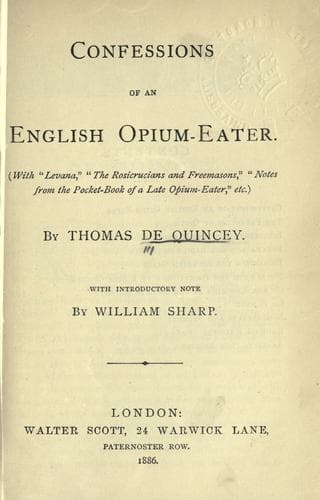
Note Book of an English Opium-EaterDe Quincey, Thomas
Philosophy
Note Book of an English Opium-Eater
De Quincey, Thomas
Opium abuse -- England
damp, &c. at a depth of seven or eight feet below the surface of the
earth; and on their death-beds to communicate the knowledge of this fact
to some confidential friends, who in their turn were to send down the
tradition to some discreet persons of the next generation; and thus, if
the truth was not to be dispersed for many ages, yet the knowledge that
here and there the truth lay buried on this and that continent, in secret
spots on Mount Caucasus--in the sands of Biledulgerid--and in hiding-
places amongst the forests of America, and was to rise again in some
distant age and to vegetate and fructify for the universal benefit of
man,--this knowledge at least was to be whispered down from generation to
generation; and, in defiance of a myriad of kings crusading against him,
Walking Stewart was to stretch out the influence of his writings through a
long series of [Greek: _lampadophoroi_] to that child of nature whom
he saw dimly through a vista of many centuries. If this were madness, it
seemed to me a somewhat sublime madness: and I assured him of my co-
operation against the kings, promising that I would bury 'The Harp of
Apollo' in my own orchard in Grasmere at the foot of Mount Fairfield; that
I would bury 'The Apocalypse of Nature' in one of the coves of Helvellyn,
and several other works in several other places best known to myself. He
accepted my offer with gratitude; but he then made known to me that he
relied on my assistance for a still more important service--which was
this: in the lapse of that vast number of ages which would probably
intervene between the present period and the period at which his works
would have reached their destination, he feared that the English language
might itself have mouldered away. 'No!' I said, '_that_ was not probable:
considering its extensive diffusion, and that it was now transplanted into
all the continents of our planet, I would back the English language
against any other on earth.' His own persuasion however was, that the
Latin was destined to survive all other languages; it was to be the
eternal as well as the universal language; and his desire was that
I would translate his works, or some part of them, into that language. [2]
This I promised; and I seriously designed at some leisure hour to
translate into Latin a selection of passages which should embody an
abstract of his philosophy. This would have been doing a service to all
those who might wish to see a digest of his peculiar opinions cleared from
the perplexities of his peculiar diction and brought into a narrow compass
from the great number of volumes through which they are at present
dispersed. However, like many another plan of mine, it went unexecuted.
Public-domain text, read in full here on John Shaqi.
Reviews
Reviews
No reviews yet
Be the first to share your thoughts on this work.
Elsewhere in the archive
Join the Discussion
Join the discussion
Sign in to leave a comment or review.
Sign InorCreate an account