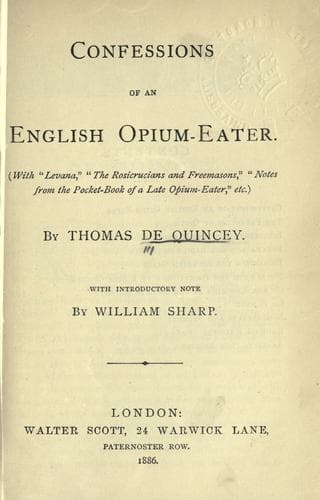
Note Book of an English Opium-EaterDe Quincey, Thomas
Philosophy
Note Book of an English Opium-Eater
De Quincey, Thomas
Opium abuse -- England
aspirations in connection with human nature generally and its hopes; and
like him he strove to give steadiness, a uniform direction, and an
intelligible purpose to these feelings, by fitting to them a scheme of
philosophical opinions. But unfortunately the philosophic system of both
was so far from supporting their own views and the cravings of their own
enthusiasm, that, as in some points it was baseless, incoherent, or
unintelligible, so in others it tended to moral results, from which, if
they had foreseen them, they would have been themselves the first to
shrink as contradictory to the very purposes in which their system had
originated. Hence, in maintaining their own system they both found
themselves painfully entangled at times with tenets pernicious and
degrading to human nature. These were the inevitable consequences of the
[Greek: _proton pheudos_] in their speculations; but were naturally
charged upon them by those who looked carelessly into their books as
opinions which not only for the sake of consistency they thought
themselves bound to endure, but to which they gave the full weight of
their sanction and patronage as to so many moving principles in their
system. The other disadvantage under which Walking Stewart labored, was
this: he was a man of genius, but not a man of talents; at least his
genius was out of all proportion to his talents, and wanted an organ as it
were for manifesting itself; so that his most original thoughts were
delivered in a crude state--imperfect, obscure, half developed, and not
producible to a popular audience. He was aware of this himself; and,
though he claims everywhere the faculty of profound intuition into human
nature, yet with equal candor he accuses himself of asinine stupidity,
dulness, and want of talent. He was a disproportioned intellect, and so
far a monster: and he must be added to the long list of original-minded
men who have been looked down upon with pity and contempt by commonplace
men of talent, whose powers of mind--though a thousand times inferior--
were yet more manageable, and ran in channels more suited to common uses
and common understandings.
FOOTNOTES
[1] In Bath, he was surnamed 'the Child of Nature;'--which arose from his
contrasting on every occasion the existing man of our present experience
with the ideal or Stewartian man that might be expected to emerge in some
myriads of ages; to which latter man he gave the name of the Child of
Nature.
Public-domain text, read in full here on John Shaqi.
Reviews
Reviews
No reviews yet
Be the first to share your thoughts on this work.
Elsewhere in the archive
Join the Discussion
Join the discussion
Sign in to leave a comment or review.
Sign InorCreate an account