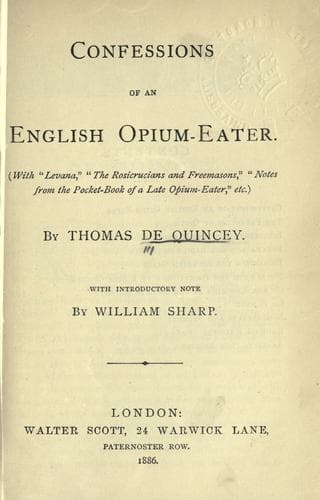
Note Book of an English Opium-EaterDe Quincey, Thomas
Philosophy
Note Book of an English Opium-Eater
De Quincey, Thomas
Opium abuse -- England
[2] I was not aware until the moment of writing this passage that Walking
Stewart had publicly made this request three years after making it to
myself: opening the 'Harp of Apollo,' I have just now accidentally
stumbled on the following passage, 'This Stupendous work is destined, I
fear, to meet a worse fate than the Aloe, which as soon as it blossoms
loses its stalk. This first blossom of reason is threatened with the loss
of both its stalk and its soil: for, if the revolutionary tyrant should
triumph, he would destroy all the English books and energies of thought. I
conjure my readers to translate this work into Latin, and to bury it in
the ground, communicating on their death-beds only its place of
concealment to men of nature.'
From the title page of this work, by the way, I learn that 'the 7000th
year of Astronomical History' is taken from the Chinese tables, and
coincides (as I had supposed) with the year 1812 of our computation.
ON SUICIDE.
It is a remarkable proof of the inaccuracy with which most men read--that
Donne's _Biathanatos_ has been supposed to countenance Suicide; and
those who reverence his name have thought themselves obliged to apologize
for it by urging, that it was written before he entered the church. But
Donne's purpose in this treatise was a pious one: many authors had charged
the martyrs of the Christian church with Suicide--on the principle that if
I put myself in the way of a mad bull, knowing that he will kill me--I am
as much chargeable with an act of self-destruction as if I fling myself
into a river. Several casuists had extended this principle even to the
case of Jesus Christ: one instance of which, in a modern author, the
reader may see noticed and condemned by Kant, in his _Religion innerhalb
die gronzen der blossen Vernunft_; and another of much earlier date (as
far back as the 13th century, I think), in a commoner book--Voltaire's
notes on the little treatise of Beccaria, _Dei delitti e delle pene_.
These statements tended to one of two results: either they unsanctified
the characters of those who founded and nursed the Christian church; or
they sanctified suicide. By way of meeting them, Donne wrote his book: and
as the whole argument of his opponents turned upon a false definition of
suicide (not explicitly stated, but assumed), he endeavored to
reconstitute the notion of what is essential to create an act of suicide.
Simply to kill a man is not murder: _prima facie_, therefore, there
is some sort of presumption that simply for a man to kill himself--may not
always be so: there is such a thing as simple homicide distinct from
murder: there may, therefore, possibly be such a thing as self-homicide
distinct from self-murder. There _may_ be a ground for such a distinction,
_ex analogia_. But, secondly, on examination, _is_ there any ground for
such a distinction? Donne affirms that there is; and, reviewing several
eminent cases of spontaneous martyrdom, he endeavors to show that acts so
Public-domain text, read in full here on John Shaqi.
Reviews
Reviews
No reviews yet
Be the first to share your thoughts on this work.
Elsewhere in the archive
Join the Discussion
Join the discussion
Sign in to leave a comment or review.
Sign InorCreate an account