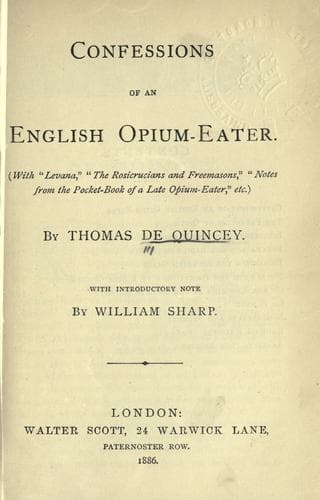
Note Book of an English Opium-EaterDe Quincey, Thomas
Philosophy
Note Book of an English Opium-Eater
De Quincey, Thomas
Opium abuse -- England
to his own nature: to raise and dignify which, I am
persuaded, is the first--last--and holiest command [1] which the
conscience imposes on the philosophic moralist. In countries, where the
traveller has the pain of seeing human creatures performing the labors of
brutes, [2]--surely the sorrow which the spectacle moves, if a wise
sorrow, will not be chiefly directed to the poor degraded individual--too
deeply degraded, probably, to be sensible of his own degradation, but to
the reflection that man's nature is thus exhibited in a state of miserable
abasement; and, what is worst of all, abasement proceeding from man
himself. Now, whenever this view of corporal punishment becomes general
(as inevitably it will, under the influence of advancing civilization), I
say, that Donne's principle will then become applicable to this case, and
it will be the duty of a man to die rather than to suffer his own nature
to be dishonored in that way. But so long as a man is not fully sensible
of the dishonor, to him the dishonor, except as a personal one, does not
wholly exist. In general, whenever a paramount interest of human nature is
at stake, a suicide which maintains that interest is self-homicide: but,
for a personal interest, it becomes self-murder. And into this principle
Donne's may be resolved.
* * * * *
A doubt has been raised--whether brute animals ever commit suicide: to me
it is obvious that they do not, and cannot. Some years ago, however, there
was a case reported in all the newspapers of an old ram who committed
suicide (as it was alleged) in the presence of many witnesses. Not having
any pistols or razors, he ran for a short distance, in order to aid the
impetus of his descent, and leaped over a precipice, at the foot of which
he was dashed to pieces. His motive to the 'rash act,' as the papers
called it, was supposed to be mere taedium vitae. But, for my part, I
doubted the accuracy of the report. Not long after a case occurred in
Westmoreland which strengthened my doubts. A fine young blood horse, who
could have no possible reason for making away with himself, unless it were
the high price of oats at that time, was found one morning dead in his
field. The case was certainly a suspicious one: for he was lying by the
side of a stone-wall, the upper part of which wall his skull had
fractured, and which had returned the compliment by fracturing his skull.
It was argued, therefore, that in default of ponds, &c. he had
deliberately hammered with his head against the wall; this, at first,
seemed the only solution; and he was generally pronounced _felo de
se_. However, a day or two brought the truth to light. The field lay
upon the side of a hill: and, from a mountain which rose above it, a
shepherd had witnessed the whole catastrophe, and gave evidence which
vindicated the character of the horse. The day had been very windy; and
the young creature being in high spirits, and, caring evidently as little
Public-domain text, read in full here on John Shaqi.
Reviews
Reviews
No reviews yet
Be the first to share your thoughts on this work.
Elsewhere in the archive
Join the Discussion
Join the discussion
Sign in to leave a comment or review.
Sign InorCreate an account