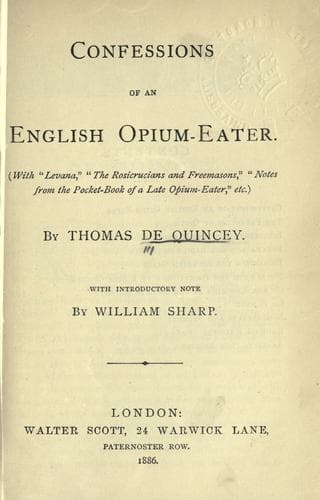
Note Book of an English Opium-EaterDe Quincey, Thomas
Philosophy
Note Book of an English Opium-Eater
De Quincey, Thomas
Opium abuse -- England
motived and so circumstantiated will not come within the notion of suicide
properly defined. Meantime, may not this tend to the encouragement of
suicide in general, and without discrimination of its species? No: Donne's
arguments have no prospective reference or application; they are purely
retrospective. The circumstances necessary to create an act of mere self-
homicide can rarely concur, except in a state of disordered society, and
during the _cardinal_ revolutions of human history: where, however, they
_do_ concur, there it will not be suicide. In fact, this is the natural
and practical judgment of us all. We do not all agree on the particular
cases which will justify self-destruction: but we all feel and
involuntarily acknowledge (_implicitly_ acknowledge in our admiration,
though not explicitly in our words or in our principles), that there _are_
such cases. There is no man, who in his heart would not reverence a woman
that chose to die rather than to be dishonored: and, if we do not say,
that it is her duty to do so, _that_ is because the moralist must
condescend to the weakness and infirmities of human nature: mean and
ignoble natures must not be taxed up to the level of noble ones. Again,
with regard to the other sex, corporal punishment is its peculiar and
_sexual_ degradation; and if ever the distinction of Donne can be applied
safely to any case, it will be to the case of him who chooses to die
rather than to submit to that ignominy. _At present_, however, there is
but a dim and very confined sense, even amongst enlightened men (as we may
see by the debates of Parliament), of the injury which is done to human
nature by giving legal sanction to such brutalizing acts; and therefore
most men, in seeking to escape it, would be merely shrinking from a
_personal_ dishonor. Corporal punishment is usually argued with a single
reference to the case of him who suffers it; and _so_ argued, God knows
that it is worthy of all abhorrence: but the weightiest argument against
it--is the foul indignity which is offered to our common nature lodged in
the person of him on whom it is inflicted. _His_ nature is _our_ nature:
and, supposing it possible that _he_ were so far degraded as to be
unsusceptible of any influences but those which address him through the
brutal part of his nature, yet for the sake of ourselves--No! not merely
for ourselves, or for the human race now existing, but for the sake of
human nature, which trancends all existing participators of that nature--
we should remember that the evil of corporal punishment is not to be
measured by the poor transitory criminal, whose memory and offence are
soon to perish: these, in the sum of things, are as nothing: the injury
which can be done him, and the injury which he can do, have so momentary
an existence that they may be safely neglected: but the abiding injury is
to the most august interest which for the mind of man can have any
existence,--viz.
Public-domain text, read in full here on John Shaqi.
Reviews
Reviews
No reviews yet
Be the first to share your thoughts on this work.
Elsewhere in the archive
Join the Discussion
Join the discussion
Sign in to leave a comment or review.
Sign InorCreate an account