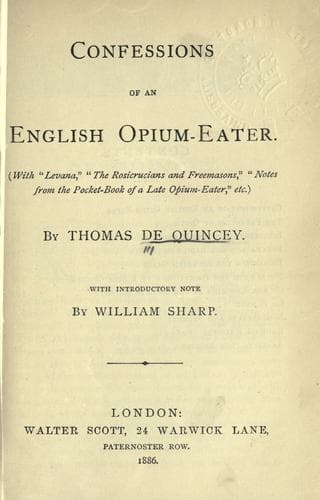
Note Book of an English Opium-EaterDe Quincey, Thomas
Philosophy
Note Book of an English Opium-Eater
De Quincey, Thomas
Opium abuse -- England
It is asserted that this is the age of Superficial Knowledge; and amongst
the proofs of this assertion we find Encyclopaedias and other popular
abstracts of knowledge particularly insisted on. But in this notion and
its alleged proofs there is equal error--wherever there is much diffusion
of knowledge, there must be a good deal of superficiality: prodigious
_extension_ implies a due proportion of weak _intension_; a sea-like
expansion of knowledge will cover large shallows as well as large
depths. But in that quarter in which it is superficially cultivated the
intellect of this age is properly opposed in any just comparison to an
intellect without any culture at all:--leaving the deep soils out of the
comparison, the shallow ones of the present day would in any preceding one
have been barren wastes. Of this our modern encyclopedias are the best
proof. For whom are they designed, and by whom used?--By those who in a
former age would have gone to the fountain heads? No, but by those who in
any age preceding the present would have drunk at no waters at all.
Encyclopedias are the growth of the last hundred years; not because those
who were formerly students of higher learning have descended, but because
those who were below encyclopaedias have ascended. The greatness of the
ascent is marked by the style in which the more recent encyclopaedias are
executed: at first they were mere abstracts of existing books--well or ill
executed: at present they contain many _original_ articles of great
merit. As in the periodical literature of the age, so in the
encyclopaedias it has become a matter of ambition with the publishers to
retain the most eminent writers in each several department. And hence it
is that our encyclopaedias now display one characteristic of this age--the
very opposite of superficiality (and which on other grounds we are well
assured of)--viz. its tendency in science, no less than in other
applications of industry, to extreme subdivision. In all the employments
which are dependent in any degree upon the political economy of nations,
this tendency is too obvious to have been overlooked. Accordingly it has
long been noticed for congratulation in manufactures and the useful arts--
and for censure in the learned professions. We have now, it is alleged, no
great and comprehensive lawyers like Coke: and the study of medicine is
subdividing itself into a distinct ministry (as it were) not merely upon
the several organs of the body (oculists, aurists, dentists,
cheiropodists, &c.) but almost upon the several diseases of the same
organ: one man is distinguished for the treatment of liver complaints of
one class--a second for those of another class; one man for asthma--
another for phthisis; and so on. As to the law, the evil (if it be one)
lies in the complex state of society which of necessity makes the laws
complex: law itself is become unwieldy and beyond the grasp of one man's
Public-domain text, read in full here on John Shaqi.
Reviews
Reviews
No reviews yet
Be the first to share your thoughts on this work.
Elsewhere in the archive
Join the Discussion
Join the discussion
Sign in to leave a comment or review.
Sign InorCreate an account