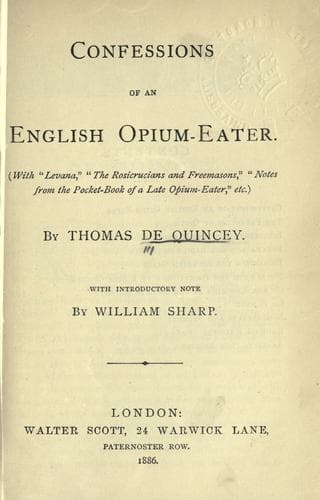
Note Book of an English Opium-EaterDe Quincey, Thomas
Philosophy
Note Book of an English Opium-Eater
De Quincey, Thomas
Opium abuse -- England
term of life and possible range of experience: and will never again come
within them. With respect to medicine, the case is no evil but a great
benefit--so long as the subdividing principle does not descend too low to
allow of a perpetual re-ascent into the generalizing principle (the
[Greek: _to_] commune) which secures the unity of the science. In
ancient times all the evil of such a subdivision was no doubt realized in
Egypt: for there a distinct body of professors took charge of each organ
of the body, not (as we may be assured) from any progress of the science
outgrowing the time and attention of the general professor, but simply
from an ignorance of the organic structure of the human body and the
reciprocal action of the whole upon each part and the parts upon the
whole; an ignorance of the same kind which has led sailors seriously (and
not merely, as may sometimes have happened, by way of joke) to reserve one
ulcerated leg to their own management, whilst the other was given up to
the management of the surgeon. With respect to law and medicine then, the
difference between ourselves and our ancestors is not subjective but
objective; not, _i.e._ in our faculties who study them, but in the
things themselves which are the objects of study: not we (the students)
are grown less, but they (the studies) are grown bigger;--and that our
ancestors did not subdivide as much as we do--was something of their luck,
but no part of their merit. Simply as subdividers therefore to the extent
which now prevails, we are less superficial than any former age. In all
parts of science the same principle of subdivision holds: here therefore,
no less than in those parts of knowledge which are the subjects of
distinct civil professions, we are of necessity more profound than our
ancestors; but, for the same reason, less comprehensive than they. Is it
better to be a profound student, or a comprehensive one? In some degree
this must depend upon the direction of the studies: but generally, I
think, it is better for the interests of knowledge that the scholar should
aim at profundity, and better for the interests of the individual that he
should aim at comprehensiveness. A due balance and equilibrium of the mind
is but preserved by a large and multiform knowledge: but knowledge itself
is but served by an exclusive (or at least paramount) dedication of one
mind to one science. The first proposition is perhaps unconditionally
true: but the second with some limitations. There are such people as
Leibnitzes on this earth; and their office seems not that of planets--to
revolve within the limits of one system, but that of comets (according to
the theory of some speculators)--to connect different systems together. No
doubt there is much truth in this: a few Leibnitzes in every age would be
of much use: but neither are many men fitted by nature for the part of
Leibnitz; nor would the aspect of knowledge be better, if they were. We
Public-domain text, read in full here on John Shaqi.
Reviews
Reviews
No reviews yet
Be the first to share your thoughts on this work.
Elsewhere in the archive
Join the Discussion
Join the discussion
Sign in to leave a comment or review.
Sign InorCreate an account