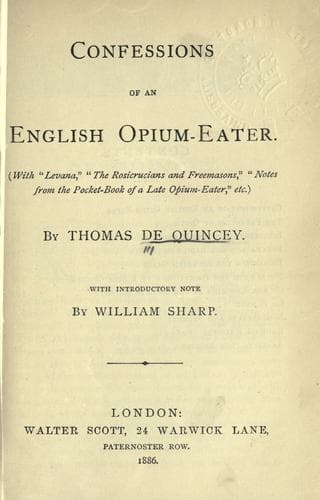
Note Book of an English Opium-EaterDe Quincey, Thomas
Philosophy
Note Book of an English Opium-Eater
De Quincey, Thomas
Opium abuse -- England
In what degree each party is right, may be judged from this consideration
--that no word can ever deviate from its first meaning _per saltum_:
each successive stage of meaning must always have been determined by that
which preceded. And on this one law depends the whole philosophy of the
case: for it thus appears that the original and primitive sense of the
word will contain virtually all which can ever afterwards arise: as in the
_evolution_-theory of generation, the whole series of births is
represented as involved in the first parent. Now, if the evolution of
successive meanings has gone on rightly, _i.e._ by simply lapsing
through a series of close affinities, there can be no reason for recurring
to the primitive meaning of the word: but, if it can be shown that the
evolution has been faulty, _i.e._ that the chain of true affinities
has ever been broken through ignorance, then we have a right to reform the
word, and to appeal from the usage ill-instructed to a usage better-
instructed. Whether we ought to exercise this right, will depend on a
consideration which I will afterwards notice. Meantime I will first give a
few instances of faulty evolution.
1. _Implicit_. This word is now used in a most ignorant way; and from
its misuse it has come to be a word wholly useless: for it is now never
coupled, I think, with any other substantive than these two--faith and
confidence: a poor domain indeed to have sunk to from its original wide
range of territory. Moreover, when we say, _implicit faith_, or
_implicit confidence_, we do not thereby indicate any specific _kind_ of
faith and confidence differing from other faith or other confidence: but
it is a vague rhetorical word which expresses a great _degree_ of faith
and confidence; a faith that is unquestioning, a confidence that is
unlimited; _i.e._ in fact, a faith that _is_ a faith, a confidence that
_is_ a confidence. Such a use of the word ought to be abandoned to women:
doubtless, when sitting in a bower in the month of May, it is pleasant to
hear from a lovely mouth--'I put implicit confidence in your honor:' but,
though pretty and becoming to such a mouth, it is very unfitting to the
mouth of a scholar: and I will be bold to affirm that no man, who had ever
acquired a scholar's knowledge of the English language, has used the word
in that lax and unmeaning way. The history of the word is this.--
_Implicit_ (from the Latin _implicitus_, involved in, folded up) was
always used originally, and still is so by scholars, as the direct
antithete of explicit (from the Latin _explicitus_, evolved, unfolded):
and the use of both may be thus illustrated.
_Q._ 'Did Mr. A. ever say that he would marry Miss B.?'--_A._ 'No; not
explicitly (_i.e._ in so many words); but he did implicitly--by showing
great displeasure if she received attentions from any other man; by asking
her repeatedly to select furniture for his house; by consulting her on his
own plans of life.'
Public-domain text, read in full here on John Shaqi.
Reviews
Reviews
No reviews yet
Be the first to share your thoughts on this work.
Elsewhere in the archive
Join the Discussion
Join the discussion
Sign in to leave a comment or review.
Sign InorCreate an account