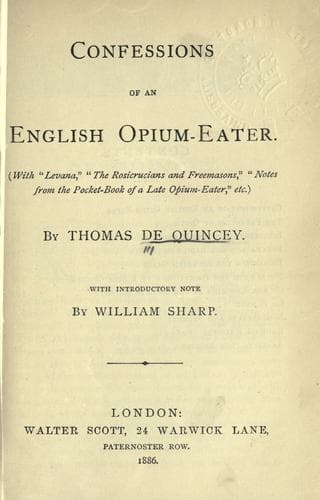
Note Book of an English Opium-EaterDe Quincey, Thomas
Philosophy
Note Book of an English Opium-Eater
De Quincey, Thomas
Opium abuse -- England
Partial exercise of the faculties (literally
"_one-sidedness_ in the exercise of the faculties") leads the individual
undoubtedly into error, but the species into truth. In no other way than
by concentrating the whole energy of our spirit, and by converging our
whole being, so to speak, into a single faculty, can we put wings as it
were to the individual faculty and carry it by this artificial flight far
beyond the limits within which nature has else doomed it to walk. Just as
certain as it is that all human beings could never, by clubbing their
visual powers together, have arrived at the power of seeing what the
telescope discovers to the astronomer; just so certain it is that
the human intellect would never have arrived at an analysis of the
infinite or a _Critical Analysis of the Pure Reason_ (the principal
work of Kant), unless individuals had dismembered (as it were) and
insulated this or that specific faculty, and had thus armed their
intellectual sight by the keenest abstraction and by the submersion of the
other powers of their nature. Extraordinary men are formed then by
energetic and over-excited spasms as it were in the individual faculties;
though it is true that the equable exercise of all the faculties in
harmony with each other can alone make happy and perfect men.' After this
statement, from which it should seem that in the progress of society
nature has made it necessary for man to sacrifice _his own_ happiness
to the attainment of _her_ ends in the development of his species,
Schiller goes on to inquire whether this evil result cannot be remedied;
and whether 'the totality of our nature, which art has destroyed, might
not be re-established by a higher art,'--but this, as leading to a
discussion beyond the limits of my own, I omit.
ENGLISH DICTIONARIES.
It has already, I believe, been said more than once in print that one
condition of a good dictionary would be to exhibit the _history_ of
each word; that is, to record the exact succession of its meanings. But
the philosophic reason for this has not been given; which reason, by the
way, settles a question often agitated, viz. whether the true meaning of a
word be best ascertained from its etymology, or from its present use and
acceptation. Mr. Coleridge says, 'the best explanation of a word is often
that which is suggested by its derivation' (I give the substance of his
words from memory). Others allege that we have nothing to do with the
primitive meaning of the word; that the question is--what does it mean
now? and they appeal, as the sole authority they acknowledge, to the
received--
Usus, penes quem est jus et norma loquendi.
Public-domain text, read in full here on John Shaqi.
Reviews
Reviews
No reviews yet
Be the first to share your thoughts on this work.
Elsewhere in the archive
Join the Discussion
Join the discussion
Sign in to leave a comment or review.
Sign InorCreate an account