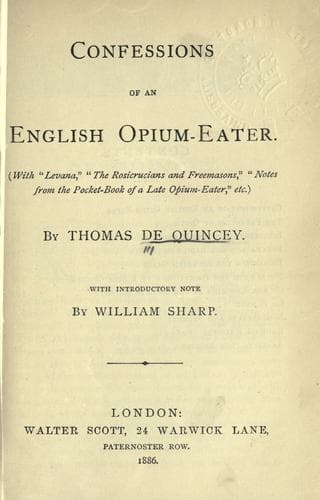
Note Book of an English Opium-EaterDe Quincey, Thomas
Philosophy
Note Book of an English Opium-Eater
De Quincey, Thomas
Opium abuse -- England
Thus much for the primitive use of the word _implicit_. Now, with
regard to the history of its transition into its present use, it is
briefly this; and it will appear at once, that it has arisen through
ignorance. When it was objected to a papist that his church exacted an
assent to a great body of traditions and doctrines to which it was
impossible that the great majority could be qualified, either as respected
time--or knowledge--or culture of the understanding, to give any
reasonable assent,--the answer was: 'Yes; but that sort of assent is not
required of a poor uneducated man; all that he has to do--is to believe in
the church: he is to have faith in _her_ faith: by that act he adopts
for his own whatsoever the church believes, though he may never have hoard
of it even: his faith is implicit, _i.e._ involved and wrapped up in
the faith of the church, which faith he firmly believes to be the true
faith upon the conviction he has that the church is preserved from all
possibility of erring by the spirit of God.' [2] Now, as this sort of
believing by proxy or implicit belief (in which the belief was not
_immediate_ in the thing proposed to the belief, but in the authority
of another person who believed in that thing and thus _mediately_ in
the thing itself) was constantly attacked by the learned assailants of
popery,--it naturally happened that many unlearned readers of these
protestant polemics caught at a phrase which was so much bandied between
the two parties: the spirit of the context sufficiently explained to them
that it was used by protestants as a term of reproach, and indicated a
faith that was an erroneous faith by being too easy--too submissive--and
too passive: but the particular mode of this erroneousness they seldom
came to understand, as learned writers naturally employed the term without
explanation, presuming it to be known to those whom they addressed. Hence
these ignorant readers caught at the last _result_ of the phrase 'implicit
faith' rightly, truly supposing it to imply a resigned and unquestioning
faith; but they missed the whole immediate cause of meaning by which only
the word 'implicit' could ever have been entitled to express that result.
Public-domain text, read in full here on John Shaqi.
Reviews
Reviews
No reviews yet
Be the first to share your thoughts on this work.
Elsewhere in the archive
Join the Discussion
Join the discussion
Sign in to leave a comment or review.
Sign InorCreate an account