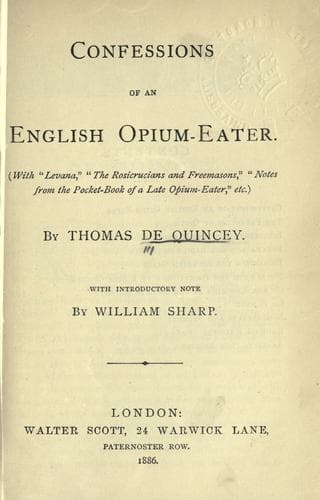
Note Book of an English Opium-EaterDe Quincey, Thomas
Philosophy
Note Book of an English Opium-Eater
De Quincey, Thomas
Opium abuse -- England
I have allowed myself to say so much on this word 'implicit,' because the
history of the mode by which its true meaning was lost applies almost to
all other corrupted words--_mutatis mutandis_: and the amount of it
may be collected into this formula,--that the _result_ of the word is
apprehended and retained, but the _schematismus_ by which that result
was ever reached is lost. This is the brief theory of all corruption of
words. The word _schematismus_ I have unwillingly used, because no
other expresses my meaning. So great and extensive a doctrine however
lurks in this word, that I defer the explanation of it to a separate
article. Meantime a passable sense of the word will occur to every body
who reads Greek. I now go on to a few more instances of words that have
forfeited their original meaning through the ignorance of those who used
them.
'_Punctual._' This word is now confined to the meagre denoting of
accuracy in respect to time--fidelity to the precise moment of an
appointment. But originally it was just as often, and just as reasonably,
applied to space as to time; 'I cannot punctually determine the origin of
the Danube; but I know in general the district in which it rises, and that
its fountain is near that of the Rhine.' Not only, however, was it applied
to time and space, but it had a large and very elegant figurative use.
Thus in the History of the Royal Society by Sprat (an author who was
finical and nice in his use of words)--I remember a sentence to this
effect: 'the Society gave punctual directions for the conducting of
experiments;' _i.e._ directions which descended to the minutiae and
lowest details. Again in the once popular romance of Parismus Prince of
Bohemia--'She' (I forget who) 'made a punctual relation of the whole
matter;' _i.e._ a relation which was perfectly circumstantial and
true to the minutest features of the case.
FOOTNOTES
[1] Among the most shocking of the unscholarlike barbarisms, now
prevalent, I must notice the use of the word '_nice_' in an objective
instead of a subjective sense: '_nice_' does not and cannot express a
quality of the object, but merely a quality of the subject: yet we hear
daily of 'a very nice letter'--'a nice young lady,' &c., meaning a letter
or a young lady that it is pleasant to contemplate: but 'a nice young
lady'--means a fastidious young lady; and 'a nice letter' ought to mean a
letter that is very delicate in its rating and in the choice of its
company.
Public-domain text, read in full here on John Shaqi.
Reviews
Reviews
No reviews yet
Be the first to share your thoughts on this work.
Elsewhere in the archive
Join the Discussion
Join the discussion
Sign in to leave a comment or review.
Sign InorCreate an account