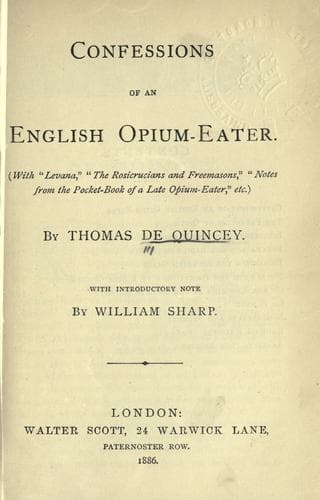
Note Book of an English Opium-EaterDe Quincey, Thomas
Philosophy
Note Book of an English Opium-Eater
De Quincey, Thomas
Opium abuse -- England
reasons for thinking that he must have been a person familiarly known to
Marr. He had entered the shop by opening the door after it had been closed
by Marr. But it was justly argued--that, after the caution conveyed to
Marr by the watchman, the appearance of any stranger in the shop at that
hour, and in so dangerous a neighborhood, and entering by so irregular and
suspicious a course, (_i.e._, walking in after the door had been closed,
and after the closing of the shutters had cut off all open communication
with the street), would naturally have roused Marr to an attitude of
vigilance and self-defence. Any indication, therefore, that Marr had _not_
been so roused, would argue to a certainty that _something_ had occurred
to neutralize this alarm, and fatally to disarm the prudent jealousies of
Marr. But this 'something' could only have lain in one simple fact, viz.,
that the person of the murderer was familiarly known to Marr as that of an
ordinary and unsuspected acquaintance. This being presupposed as the key
to all the rest, the whole course and evolution of the subsequent drama
becomes clear as daylight. The murderer, it is evident, had opened gently,
and again closed behind him with equal gentleness, the street-door. He had
then advanced to the little counter, all the while exchanging the ordinary
salutation of an old acquaintance with the unsuspecting Marr. Having
reached the counter, he would then ask Marr for a pair of unbleached
cotton socks. In a shop so small as Marr's, there could be no great
latitude of choice for disposing of the different commodities. The
arrangement of these had no doubt become familiar to the murderer; and he
had already ascertained that, in order to reach down the particular parcel
wanted at present, Marr would find it requisite to face round to the rear,
and, at the same moment, to raise his eyes and his hands to a level
eighteen inches above his own head. This movement placed him in the most
disadvantageous possible position with regard to the murderer, who now, at
the instant when Marr's hands and eyes were embarrassed, and the back of
his head fully exposed, suddenly from below his large surtout, had unslung
a heavy ship-carpenter's mallet, and, with one solitary blow, had so
thoroughly stunned his victim, as to leave him incapable of resistance.
The whole position of Marr told its own tale. He had collapsed naturally
behind the counter, with his hands so occupied as to confirm the whole
outline of the affair as I have here suggested it. Probable enough it is
that the very first blow, the first indication of treachery that reached
Marr, would also be the last blow as regarded the abolition of
consciousness. The murderer's plan and _rationale_ of murder started
systematically from this infliction of apoplexy, or at least of a stunning
sufficient to insure a long loss of consciousness. This opening step
placed the murderer at his ease. But still, as returning sense might
Public-domain text, read in full here on John Shaqi.
Reviews
Reviews
No reviews yet
Be the first to share your thoughts on this work.
Join the Discussion
Join the discussion
Sign in to leave a comment or review.
Sign InorCreate an account