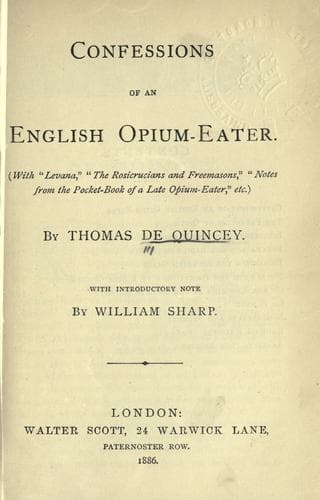
Note Book of an English Opium-EaterDe Quincey, Thomas
Philosophy
Note Book of an English Opium-Eater
De Quincey, Thomas
Opium abuse -- England
[1] It is strange, or rather it is _not_ strange, considering the
feebleness of that lady in such a field, that Miss Edgeworth always
fancied herself to have caught Milton in a bull, under circumstances
which, whilst leaving the shadow of a bull, effectually disown the
substance. 'And in the lowest deep a lower deep still opens to devour me.'
This is the passage denounced by Miss Edgeworth. 'If it was already the
lowest deep,' said the fair lady, 'how the deuce (no, perhaps it might be
_I_ that said '_how the deuce_') could it open into a lower deep?' Yes,
how could it? In carpentry, it is clear to my mind that it could _not_.
But, in cases of deep imaginative feeling, no phenomenon is more natural
than precisely this never-ending growth of one colossal grandeur chasing
and surmounting another, or of abysses that swallowed up abysses.
Persecutions of this class oftentimes are amongst the symptoms of fever,
and amongst the inevitable spontaneities of nature. Other people I have
known who were inclined to class amongst bulls Milton's all-famous
expression of '_darkness visible_,' whereas it is not even a bold or
daring expression; it describes a pure optical experience of very common
occurrence. There are two separate darknesses or obscurities: first, that
obscurity _by_ which you see dimly; and secondly, that obscurity _which_
you see. The first is the atmosphere through which vision is performed,
and, therefore, part of the _subjective_ conditions essential to the act
of seeing. The second is the _object_ of your sight. In a glass-house at
night illuminated by a sullen fire in one corner, but else dark, you see
the darkness massed in the rear as a black object. _That_ is the 'visible
darkness.' And on the other hand, the murky atmosphere between you and the
distant rear is not the object, but the medium, through or athwart which
you descry the black masses. The first darkness is _subjective_ darkness;
that is, a darkness in your own eye, and entangled with your very faculty
of vision. The second darkness is perfectly different: it is _objective_
darkness; that is to say, not any darkness which affects or modifies your
faculty of seeing either for better or worse; but a darkness which is the
_object_ of your vision; a darkness which you see projected from yourself
as a massy volume of blackness, and projected, possibly, to a vast
distance.
Public-domain text, read in full here on John Shaqi.
Reviews
Reviews
No reviews yet
Be the first to share your thoughts on this work.
Elsewhere in the archive
Join the Discussion
Join the discussion
Sign in to leave a comment or review.
Sign InorCreate an account