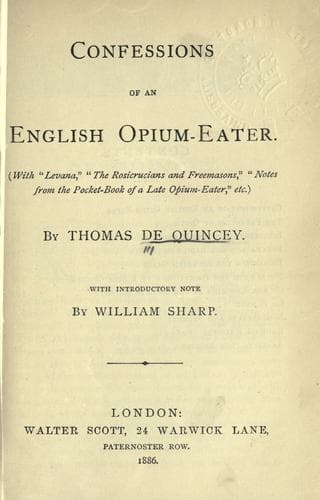
Note Book of an English Opium-EaterDe Quincey, Thomas
Philosophy
Note Book of an English Opium-Eater
De Quincey, Thomas
Opium abuse -- England
collision, and of the examination which follows, is what no reader can
ever forget--so unspeakable is the grandeur of that scene between the two
hostile archangels, when the _Fiend_ (so named at the moment under
the fine machinery used by Milton for exalting or depressing the ideas of
his nature) finally takes his flight as an incarnation of darkness,
'And fled
Murmuring; and with him fled the shades of night.
The darkness flying with him, naturally we have the feeling that he
_is_ the darkness, and that all darkness has some essential relation
to Satan.
But now, having thus witnessed his terrific expulsion, naturally we ask
what was the sequel. Four books, however, are interposed before we reach
the answer to that question. This is the reason that we fail to remark the
extraordinary oversight of Milton. Dislocated from its immediate plan in
the succession of incidents, that sequel eludes our notice, which else and
in its natural place would have shocked us beyond measure. The simple
abstract of the whole story is, that Satan, being ejected, and sternly
charged under Almighty menaces not to intrude upon the young Paradise of
God, 'rides with darkness' for exactly one week, and, having digested his
wrath rather than his fears on the octave of his solemn banishment,
without demur, or doubt, or tremor, back he plunges into the very centre
of Eden. On a Friday, suppose, he is expelled through the main entrance:
on the Friday following he re-enters upon the forbidden premises through a
clandestine entrance. The upshot is, that the heavenly police suffer, in
the first place, the one sole enemy, who was or could be the object of
their vigilance, to pass without inquest or suspicion; thus they
_inaugurate_ their task; secondly, by the merest accident (no thanks
to their fidelity) they detect him, and with awful adjurations sentence
him to perpetual banishment; but, thirdly, on his immediate return, in
utter contempt of their sentence, they ignore him altogether, and
apparently act upon Dogberry's direction, that, upon meeting a thief, the
police may suspect him to be no true man; and, with such manner of men,
the less they meddle or make, the more it will be for their honesty.
FOOTNOTE.
Public-domain text, read in full here on John Shaqi.
Reviews
Reviews
No reviews yet
Be the first to share your thoughts on this work.
Elsewhere in the archive
Join the Discussion
Join the discussion
Sign in to leave a comment or review.
Sign InorCreate an account