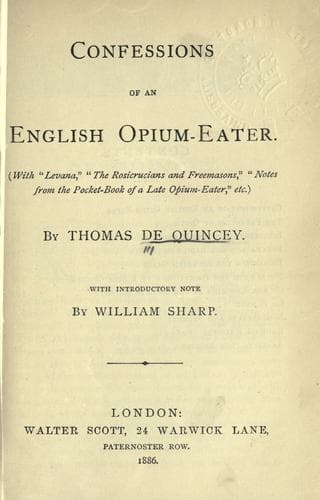
Note Book of an English Opium-EaterDe Quincey, Thomas
Philosophy
Note Book of an English Opium-Eater
De Quincey, Thomas
Opium abuse -- England
extravagance, such as is altogether wanting to the Dean's. Nobody can
pretend, for a moment, on behalf of the Dean, that there is any ordinary
and natural tendency in human thoughts, which could ever turn to infants
as articles of diet; under any conceivable circumstances, this would be
felt as the most aggravated form of cannibalism--cannibalism applying
itself to the most defenceless part of the species. But, on the other
hand, the tendency to a critical or aesthetic valuation of fires and
murders is universal. If you are summoned to the spectacle of a great
fire, undoubtedly the first impulse is--to assist in putting it out. But
that field of exertion is very limited, and is soon filled by regular
professional people, trained and equipped for the service. In the case of
a fire which is operating upon _private_ property, pity for a neighbor's
calamity checks us at first in treating the affair as a scenic spectacle.
But perhaps the fire may be confined to public buildings. And in any case,
after we have paid our tribute of regret to the affair, considered as a
calamity, inevitably, and without restraint, we go on to consider it as a
stage spectacle. Exclamations of--How grand! How magnificent! arise in a
sort of rapture from the crowd. For instance, when Drury Lane was burned
down in the first decennium of this century, the falling in of the roof
was signalized by a mimic suicide of the protecting Apollo that surmounted
and crested the centre of this roof. The god was stationary with his lyre,
and seemed looking down upon the fiery ruins that were so rapidly
approaching him. Suddenly the supporting timbers below him gave way; a
convulsive heave of the billowing flames seemed for a moment to raise the
statue; and then, as if on some impulse of despair, the presiding deity
appeared not to fall, but to throw himself into the fiery deluge, for he
went down head foremost; and in all respects, the descent had the air of a
voluntary act. What followed? From every one of the bridges over the
river, and from other open areas which commanded the spectacle, there
arose a sustained uproar of admiration and sympathy. Some few years before
this event, a prodigious fire occurred at Liverpool; the _Goree_, a vast
pile of warehouses close to one of the docks, was burned to the ground.
The huge edifice, eight or nine stories high, and laden with most
combustible goods, many thousand bales of cotton, wheat and oats in
thousands of quarters, tar, turpentine, rum, gunpowder, &c., continued
through many hours of darkness to feed this tremendous fire. To
aggravate the calamity, it blew a regular gale of wind; luckily for the
shipping, it blew inland, that is, to the east; and all the way down to
Warrington, eighteen miles distant to the eastward, the whole air was
illuminated by flakes of cotton, often saturated with rum, and by what
seemed absolute worlds of blazing sparks, that lighted up all the upper
chambers of the air.
Public-domain text, read in full here on John Shaqi.
Reviews
Reviews
No reviews yet
Be the first to share your thoughts on this work.
Join the Discussion
Join the discussion
Sign in to leave a comment or review.
Sign InorCreate an account