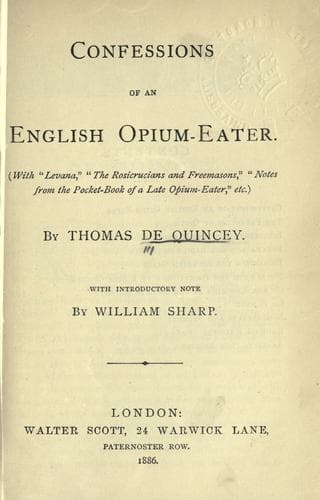
Note Book of an English Opium-EaterDe Quincey, Thomas
Philosophy
Note Book of an English Opium-Eater
De Quincey, Thomas
Opium abuse -- England
Yes, Marr's murderer--the man of mystery--was again at work; at this
moment perhaps extinguishing some lamp of life, and not at any remote
place, but here--in the very house which the listeners to this dreadful
announcement were actually touching. The chaos and blind uproar of the
scene which followed, measured by the crowded reports in the journals of
many subsequent days, and in one feature of that case, has never to my
knowledge had its parallel; or, if a parallel, only in one case--what
followed, I mean, on the acquittal of the seven bishops at Westminster in
1688. At present there was more than passionate enthusiasm. The frenzied
movement of mixed horror and exultation--the ululation of vengeance which
ascended instantaneously from the individual street, and then by a sublime
sort of magnetic contagion from all the adjacent streets, can be
adequately expressed only by a rapturous passage in Shelley:--
'The transport of a fierce and monstrous gladness
Spread through the multitudinous streets, fast flying
Upon the wings of fear:--From his dull madness
The starveling waked, and died in joy: the dying,
Among the corpses in stark agony lying,
Just heard the happy tidings, and in hope
Closed their faint eyes: from house to house replying
With loud acclaim the living shook heaven's cope,
And fill'd the startled earth with echoes.' [6]
There was something, indeed, half inexplicable in the instantaneous
interpretation of the gathering shout according to its true meaning. In
fact, the deadly roar of vengeance, and its sublime unity, _could_
point in this district only to the one demon whose idea had brooded and
tyrannized, for twelve days, over the general heart: every door, every
window in the neighborhood, flew open as if at a word of command;
multitudes, without waiting for the regular means of egress, leaped down
at once from the windows on the lower story; sick men rose from their
beds; in one instance, as if expressly to verify the image of Shelley (in
v. 4, 5, 6, 7), a man whose death had been looked for through some days,
and who actually _did_ die on the following day, rose, armed himself
with a sword, and descended in his shirt into the street. The chance was a
good one, and the mob were made aware of it, for catching the wolfish dog
in the high noon and carnival of his bloody revels--in the very centre of
his own shambles. For a moment the mob was self-baffled by its own numbers
and its own fury. But even that fury felt the call for self-control. It
was evident that the massy street-door must be driven in, since there was
no longer any living person to co-operate with their efforts from within,
excepting only a female child. Crowbars dexterously applied in one minute
threw the door out of hangings, and the people entered like a torrent. It
may be guessed with what fret and irritation to their consuming fury, a
signal of pause and absolute silence was made by a person of local
importance.
Public-domain text, read in full here on John Shaqi.
Reviews
Reviews
No reviews yet
Be the first to share your thoughts on this work.
Join the Discussion
Join the discussion
Sign in to leave a comment or review.
Sign InorCreate an account