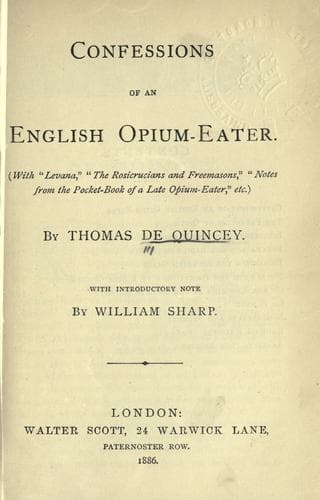
Note Book of an English Opium-EaterDe Quincey, Thomas
Philosophy
Note Book of an English Opium-Eater
De Quincey, Thomas
Opium abuse -- England
therefore had time for making an agonizing ejaculation.
It has been mentioned, that the murderer of the Marrs was not for nearly a
fortnight so much as suspected; meaning that, previously to the Williamson
murder, no vestige of any ground for suspicion in any direction whatever
had occurred either to the general public or to the police. But there were
two very limited exceptions to this state of absolute ignorance. Some of
the magistrates had in their possession something which, when closely
examined, offered a very probable means for tracing the criminal. But as
yet they had _not_ traced him. Until the Friday morning next after
the destruction of the Williamsons, they had not published the important
fact, that upon the ship-carpenter's mallet (with which, as regarded the
stunning or disabling process, the murders had been achieved) were
inscribed the letters 'J. P.' This mallet had, by a strange oversight on
the part of the murderer, been left behind in Marr's shop; and it is an
interesting fact, therefore, that, had the villain been intercepted by the
brave pawnbroker, he would have been met virtually disarmed. This public
notification was made officially on the Friday, viz., on the thirteenth
day after the first murder. And it was instantly followed (as will be
seen) by a most important result. Meantime, within the secrecy of one
single bedroom in all London, it is a fact that Williams had been
whisperingly the object of very deep suspicion from the very first--that
is, within that same hour which witnessed the Marr tragedy. And singular
it is, that the suspicion was due entirely to his own folly. Williams
lodged, in company with other men of various nations, at a public-house.
In a large dormitory there were arranged five or six beds; these were
occupied by artisans, generally of respectable character. One or two
Englishmen there were, one or two Scotchmen, three or four Germans, and
Williams, whose birth-place was not certainly known. On the fatal Saturday
night, about half-past one o'clock, when Williams returned from his
dreadful labors, he found the English and Scotch party asleep, but the
Germans awake: one of them was sitting up with a lighted candle in his
hands, and reading aloud to the other two. Upon this, Williams said, in an
angry and very peremptory tone, 'Oh, put that candle out; put it out
directly; we shall all be burned in our beds.' Had the British party in
the room been awake, Mr. Williams would have roused a mutinous protest
against this arrogant mandate. But Germans are generally mild and facile
in their tempers; so the light was complaisantly extinguished. Yet, as
there were no curtains, it struck the Germans that the danger was really
none at all; for bed-clothes, massed upon each other, will no more burn
than the leaves of a closed book. Privately, therefore, the Germans drew
an inference, that Mr. Williams must have had some urgent motive for
withdrawing his own person and dress from observation. What this motive
Public-domain text, read in full here on John Shaqi.
Reviews
Reviews
No reviews yet
Be the first to share your thoughts on this work.
Join the Discussion
Join the discussion
Sign in to leave a comment or review.
Sign InorCreate an account