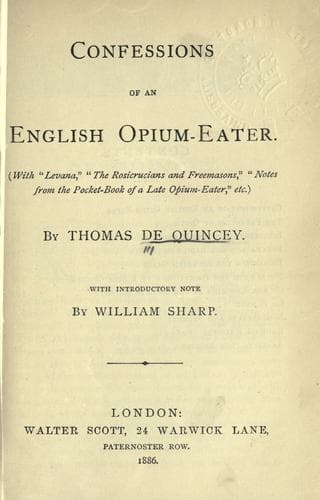
Note Book of an English Opium-EaterDe Quincey, Thomas
Philosophy
Note Book of an English Opium-Eater
De Quincey, Thomas
Opium abuse -- England
Never, throughout the annals of universal Christendom, has there indeed
been any act of one solitary insulated individual, armed with power so
appalling over the hearts of men, as that exterminating murder, by which,
during the winter of 1812, John Williams in one hour, smote two houses
with emptiness, exterminated all but two entire households, and asserted
his own supremacy above all the children of Cain. It would be absolutely
impossible adequately to describe the frenzy of feelings which, throughout
the next fortnight, mastered the popular heart; the mere delirium of
indignant horror in some, the mere delirium of panic in others. For twelve
succeeding days, under some groundless notion that the unknown murderer
had quitted London, the panic which had convulsed the mighty metropolis
diffused itself all over the island. I was myself at that time nearly
three hundred miles from London; but there, and everywhere, the panic was
indescribable. One lady, my next neighbor, whom personally I knew, living
at the moment, during the absence of her husband, with a few servants in a
very solitary house, never rested until she had placed eighteen doors (so
she told me, and, indeed, satisfied me by ocular proof), each secured by
ponderous bolts, and bars, and chains, between her own bedroom and any
intruder of human build. To reach her, even in her drawing-room, was like
going, as a flag of truce, into a beleaguered fortress; at every sixth
step one was stopped by a sort of portcullis. The panic was not confined
to the rich; women in the humblest ranks more than once died upon the
spot, from the shock attending some suspicious attempts at intrusion upon
the part of vagrants, meditating probably nothing worse than a robbery,
but whom the poor women, misled by the London newspapers, had fancied to
be the dreadful London murderer. Meantime, this solitary artist, that
rested in the centre of London, self-supported by his own conscious
grandeur, as a domestic Attila, or 'scourge of God;' this man, that walked
in darkness, and relied upon murder (as afterwards transpired) for bread,
for clothes, for promotion in life, was silently preparing an effectual
answer to the public journals; and on the twelfth day after his inaugural
murder, he advertised his presence in London, and published to all men the
absurdity of ascribing to _him_ any ruralizing propensities, by striking a
second blow, and accomplishing a second family extermination. Somewhat
lightened was the _provincial_ panic by this proof that the murderer had
not condescended to sneak into the country, or to abandon for a moment,
under any motive of caution or fear, the great metropolitan _castra
stativa_ of gigantic crime, seated for ever on the Thames. In fact, the
great artist disdained a provincial reputation; and he must have felt, as
a case of ludicrous disproportion, the contrast between a country town or
village, on the one hand, and, on the other, a work more lasting than
Public-domain text, read in full here on John Shaqi.
Reviews
Reviews
No reviews yet
Be the first to share your thoughts on this work.
Join the Discussion
Join the discussion
Sign in to leave a comment or review.
Sign InorCreate an account