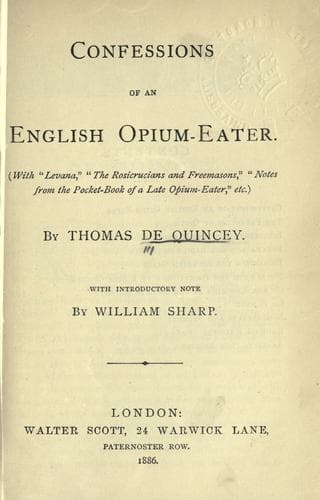
Note Book of an English Opium-EaterDe Quincey, Thomas
Philosophy
Note Book of an English Opium-Eater
De Quincey, Thomas
Opium abuse -- England
prisoners on the criminal side should be finally locked up for the night,
and without candles. For fourteen hours (that is, until seven o'clock on
the next morning) they were left unvisited, and in total darkness. Time,
therefore, Williams had for committing suicide. The means in other
respects were small. One iron bar there was, meant (if I remember) for the
suspension of a lamp; upon this he had hanged himself by his braces. At
what hour was uncertain: some people fancied at midnight. And in that
case, precisely at the hour when, fourteen days before, he had been
spreading horror and desolation through the quiet family of poor Marr, now
was he forced into drinking of the same cup, presented to his lips by the
same accursed hands.
* * * * *
The case of the M'Keans, which has been specially alluded to, merits also
a slight rehearsal for the dreadful picturesqueness of some two or three
amongst its circumstances. The scene of this murder was at a rustic inn,
some few miles (I think) from Manchester; and the advantageous situation
of this inn it was, out of which arose the two fold temptations of the
case. Generally speaking, an inn argues, of course, a close cincture of
neighbors--as the original motive for opening such an establishment. But,
in this case, the house individually was solitary, so that no interruption
was to be looked for from any persons living within reach of screams; and
yet, on the other hand, the circumjacent vicinity was eminently populous;
as one consequence of which, a benefit club had established its weekly
rendezvous in this inn, and left the peculiar accumulations in their club-
room, under the custody of the landlord. This fund arose often to a
considerable amount, fifty or seventy pounds, before it was transferred to
the hands of a banker. Here, therefore, was a treasure worth some little
risk, and a situation that promised next to none. These attractive
circumstances had, by accident, become accurately known to one or both of
the two M'Keans; and, unfortunately, at a moment of overwhelming
misfortune to themselves. They were hawkers; and, until lately, had borne
most respectable characters: but some mercantile crash had overtaken them
with utter ruin, in which their joint capital had been swallowed up to the
last shilling. This sudden prostration had made them desperate: their own
little property had been swallowed up in a large _social_ catastrophe, and
society at large they looked upon as accountable to them for a robbery. In
preying, therefore, upon society, they considered themselves as pursuing a
wild natural justice of retaliation. The money aimed at did certainly
assume the character of public money, being the product of many separate
subscriptions. They forgot, however, that in the murderous acts, which too
certainly they meditated as preliminaries to the robbery, they could plead
no such imaginary social precedent. In dealing with a family that seemed
Public-domain text, read in full here on John Shaqi.
Reviews
Reviews
No reviews yet
Be the first to share your thoughts on this work.
Join the Discussion
Join the discussion
Sign in to leave a comment or review.
Sign InorCreate an account