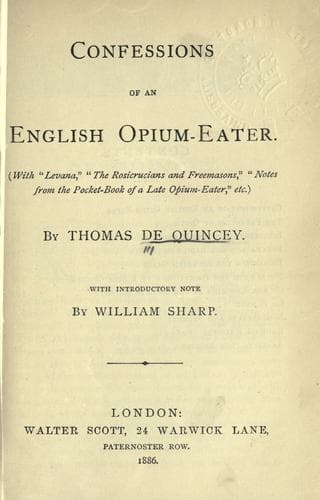
Note Book of an English Opium-EaterDe Quincey, Thomas
Philosophy
Note Book of an English Opium-Eater
De Quincey, Thomas
Opium abuse -- England
Probably they were seeking to elude the persecution of
the stage-coaches, which, for the last thirty hours, had been scattering
at all the inns and road-side _cabarets_ hand-bills describing their
persons and dress. It happened (perhaps through design) that on this
fourth morning they had separated, so as to enter the village ten minutes
apart from each other. They were exhausted and footsore. In this condition
it was easy to stop them. A blacksmith had silently reconnoitred them, and
compared their appearance with the description of the hand-bills. They
were then easily overtaken, and separately arrested. Their trial and
condemnation speedily followed at Lancaster; and in those days it
followed, of course, that they were executed. Otherwise their case fell so
far within the sheltering limits of what would _now_ be regarded as
extenuating circumstances--that, whilst a murder more or less was not to
repel them from their object, very evidently they were anxious to
economize the bloodshed as much as possible. Immeasurable, therefore, was
the interval which divided them from the monster Williams. They perished
on the scaffold: Williams, as I have said, by his own hand; and, in
obedience to the law as it then stood, he was buried in the centre of a
_quadrivium_, or conflux of four roads (in this case four streets),
with a stake driven through his heart. And over him drives for ever the
uproar of unresting London!
FOOTNOTES
[1] See 'Miscellaneous Essays,' p. 17.
[2] I am not sure whether Southey held at this time his appointment to the
editorship of the 'Edinburgh Annual Register.' If he did, no doubt in the
domestic section of that chronicle will be found an excellent account of
the whole.
[3] An artist told me in this year, 1812, that having accidentally seen a
native Devonshire regiment (either volunteers or militia), nine hundred
strong, marching past a station at which he had posted himself, he did not
observe a dozen men that would not have been described in common parlance
as 'good looking.'
[4] I do not remember, chronologically, the history of gas-lights. But in
London, long after Mr. Winsor had shown the value of gas-lighting, and its
applicability to street purposes, various districts were prevented, for
many years, from resorting to the new system, in consequence of old
contracts with oil-dealers, subsisting through long terms of years.
[5] Let the reader, who is disposed to regard as exaggerated or romantic
the pure fiendishness imputed to Williams, recollect that, except for the
luxurious purpose of basking and revelling in the anguish of dying
despair, he had no motive at all, small or great, for attempting the
murder of this young girl. She had seen nothing, heard nothing--was fast
asleep, and her door was closed; so that, as a witness against him, he
knew that she was as useless as any one of the three corpses. And yet he
_was_ making preparations for her murder, when the alarm in the street
interrupted him.
Public-domain text, read in full here on John Shaqi.
Reviews
Reviews
No reviews yet
Be the first to share your thoughts on this work.
Join the Discussion
Join the discussion
Sign in to leave a comment or review.
Sign InorCreate an account