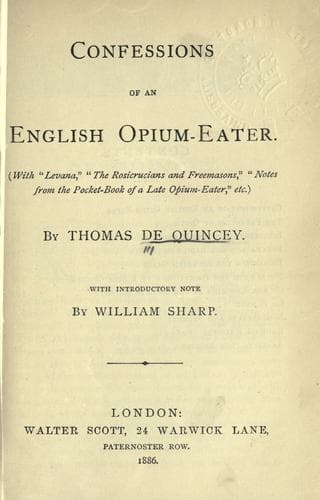
Note Book of an English Opium-EaterDe Quincey, Thomas
Philosophy
Note Book of an English Opium-Eater
De Quincey, Thomas
Opium abuse -- England
Yet, first of all, one word as to the local scene of the murders.
Ratcliffe Highway is a public thoroughfare in a most chaotic quarter of
eastern or nautical London; and at this time (viz., in 1812), when no
adequate police existed except the _detective_ police of Bow Street,
admirable for its own peculiar purposes, but utterly incommensurate to the
general service of the capital, it was a most dangerous quarter. Every
third man at the least might be set down as a foreigner. Lascars, Chinese,
Moors, Negroes, were met at every step. And apart from the manifold
ruffianism, shrouded impenetrably under the mixed hats and turbans of men
whose past was untraceable to any European eye, it is well known that the
navy (especially, in time of war, the commercial navy) of Christendom is
the sure receptacle of all the murderers and ruffians whose crimes have
given them a motive for withdrawing themselves for a season from the
public eye. It is true, that few of this class are qualified to act as
'able' seamen: but at all times, and especially during war, only a small
proportion (or _nucleus_) of each ship's company consists of such men: the
large majority being mere untutored landsmen. John Williams, however, who
had been occasionally rated as a seaman on board of various Indiamen, &c.,
was probably a very accomplished seaman. Pretty generally, in fact, he was
a ready and adroit man, fertile in resources under all sudden
difficulties, and most flexibly adapting himself to all varieties of
social life. Williams was a man of middle stature (five feet seven and
a-half, to five feet eight inches high), slenderly built, rather thin, but
wiry, tolerably muscular, and clear of all superfluous flesh. A lady, who
saw him under examination (I think at the Thames Police Office), assured
me that his hair was of the most extraordinary and vivid color, viz.,
bright yellow, something between an orange and lemon color. Williams had
been in India; chiefly in Bengal and Madras: but he had also been upon the
Indus. Now, it is notorious that, in the Punjaub, horses of a high caste
are often painted--crimson, blue, green, purple; and it struck me that
Williams might, for some casual purpose of disguise, have taken a hint
from this practice of Scinde and Lahore, so that the color might not have
been natural. In other respects, his appearance was natural enough; and,
judging by a plaster cast of him, which I purchased in London, I should
say mean, as regarded his facial structure. One fact, however, was
striking, and fell in with the impression of his natural tiger character,
that his face wore at all times a bloodless ghastly pallor. 'You might
imagine,' said my informant, 'that in his veins circulated not red life-
blood, such as could kindle into the blush of shame, of wrath, of pity--
but a green sap that welled from no human heart.' His eyes seemed frozen
and glazed, as if their light were all converged upon some victim lurking
in the far background.
Public-domain text, read in full here on John Shaqi.
Reviews
Reviews
No reviews yet
Be the first to share your thoughts on this work.
Join the Discussion
Join the discussion
Sign in to leave a comment or review.
Sign InorCreate an account