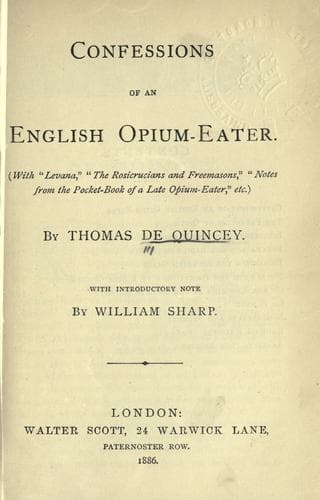
Note Book of an English Opium-EaterDe Quincey, Thomas
Philosophy
Note Book of an English Opium-Eater
De Quincey, Thomas
Opium abuse -- England
I blame neither party. It ought not to be expected of any _popular_
body that it should be patient of abstractions amongst the intensities of
party-strife, and the immediate necessities of voting. No deliberative
body would less have tolerated such philosophic exorbitations from public
business than the _agora_ of Athens, or the Roman senate. So far the
error was in Burke, not in the House of Commons. Yet, also, on the other
side, it must be remembered, that an intellect of Burke's combining power
and enormous compass, could not, from necessity of nature, abstain from
such speculations. For a man to reach a remote posterity, it is sometimes
necessary that he should throw his voice over to them in a vast arch--it
must sweep a parabola--which, therefore, rises high above the heads of
those next to him, and is heard by the bystanders but indistinctly, like
bees swarming in the upper air before they settle on the spot fit for
hiving.
See, therefore, the immeasurableness of misconception. Of all public men,
that stand confessedly in the first rank as to splendor of intellect,
Burke was the _least_ popular at the time when our blind friend Schlosser
assumes him to have run off with the lion's share of popularity. Fox, on
the other hand, as the leader of opposition, was at that time a household
term of love or reproach, from one end of the island to the other. To the
very children playing in the streets, Pitt and Fox, throughout Burke's
generation, were pretty nearly as broad distinctions, and as much a war-
cry, as English and French, Roman and Punic. Now, however, all this is
altered. As regards the relations between the two Whigs whom Schlosser so
steadfastly delighteth to misrepresent,
'Now is the winter of our discontent
Made glorious summer'
for that intellectual potentate, Edmund Burke, the man whose true mode of
power has never yet been truly investigated; whilst Charles Fox is known
only as an echo is known, and for any real _effect_ of intellect upon
this generation, for anything but the 'whistling of a name,' the Fox of
1780-1807 sleeps where the carols of the larks are sleeping, that
gladdened the spring-tides of those years--sleeps with the roses that
glorified the beauty of their summers. [10]
JUNIUS
Public-domain text, read in full here on John Shaqi.
Reviews
Reviews
No reviews yet
Be the first to share your thoughts on this work.
Elsewhere in the archive
Join the Discussion
Join the discussion
Sign in to leave a comment or review.
Sign InorCreate an account