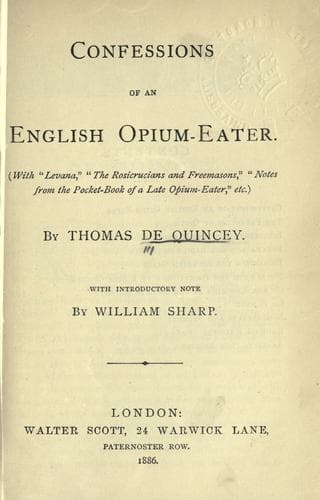
Note Book of an English Opium-EaterDe Quincey, Thomas
Philosophy
Note Book of an English Opium-Eater
De Quincey, Thomas
Opium abuse -- England
Schlosser talks of Junius, who is to him, as to many people, more than
entirely the enigma of an enigma, Hermes Trismegistus, or the mediaeval
Prester John. Not only are most people unable to solve the enigma, but
they have no idea of what it is that they are to solve. I have to inform
Schlosser that there are three separate questions about Junius, of which
he has evidently no distinct knowledge, and cannot, therefore, have many
chances to spare for settling them. The three questions are these:--A. Who
_was_ Junius? B. What was it that armed Junius with a power so
unaccountable at this day over the public mind? C. Why, having actually
exercised this power, and gained under his masque far more than he ever
hoped to gain, did this Junius not come forward _in his own person_,
when all the legal danger had long passed away, to claim a distinction
that for _him_ (among the vainest of men) must have been more precious
than his heart's blood? The two questions, B and C, I have examined in
past times, and I will not here repeat my explanations further than to
say, with respect to the last, that the reason for the author not claiming
his own property was this, because he _dared_ not; because it would have
been _infamy_ for him to avow himself as Junius; because it would have
revealed a crime and published a crime in his own earlier life, for which
many a man is transported in our days, and for less than which many a man
has been in past days hanged, broken on the wheel, burned, gibbeted, or
impaled. To say that he watched and listened at his master's key-holes, is
nothing. It was not key-holes only that he made free with, but keys; he
tampered with his master's seals; he committed larcenies; not, like a
brave man, risking his life on the highway, but petty larcenies--larcenies
in a dwelling-house--larcenies under the opportunities of a confidential
situation--crimes which formerly, in the days of Junius, our bloody code
never pardoned in villains of low degree. Junius was in the situation of
Lord Byron's Lara, or, because Lara is a plagiarism, of Harriet Lee's
Kraitzrer. But this man, because he had money, friends, and talents,
instead of going to prison, took himself off for a jaunt to the continent.
From the continent, in full security and in possession of the _otium cum
dignitate_, he negotiated with the government, whom he had alarmed by
publishing the secrets which he had stolen. He succeeded. He sold himself
to great advantage. Bought and sold he was; and of course it is understood
that, if you buy a knave, and expressly in consideration of his knaveries,
you secretly undertake not to hang him. 'Honor bright!' Lord Barrington
might certainly have indicted Junius at the Old Bailey, and had a reason
for wishing to do so; but George III., who was a party to the negotiation,
and all his ministers, would have said, with fits of laughter--'Oh, come
now, my lord, you must _not_ do that. For, since we have bargained for a
Public-domain text, read in full here on John Shaqi.
Reviews
Reviews
No reviews yet
Be the first to share your thoughts on this work.
Elsewhere in the archive
Join the Discussion
Join the discussion
Sign in to leave a comment or review.
Sign InorCreate an account