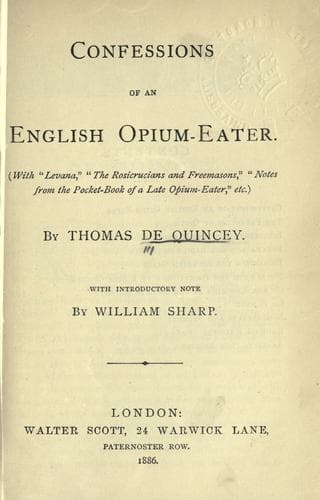
Note Book of an English Opium-EaterDe Quincey, Thomas
Philosophy
Note Book of an English Opium-Eater
De Quincey, Thomas
Opium abuse -- England
Williams, there is reason to
believe, when he went out for a grand compound massacre (in another sense,
one might have applied to it the Oxford phrase of _going out as Grand
Compounder_), always assumed black silk stockings and pumps; nor would he
on any account have degraded his position as an artist by wearing a
morning gown. In his second great performance, it was particularly noticed
and recorded by the one sole trembling man, who under killing agonies of
fear was compelled (as the reader will find) from a secret stand to become
the solitary spectator of his atrocities, that Mr. Williams wore a long
blue frock, of the very finest cloth, and richly lined with silk. Amongst
the anecdotes which circulated about him, it was also said at the time,
that Mr. Williams employed the first of dentists, and also the first of
chiropodists. On no account would he patronize any second-rate skill. And
beyond a doubt, in that perilous little branch of business which was
practised by himself, he might be regarded as the most aristocratic and
fastidious of artists.
But who meantime was the victim, to whose abode he was hurrying? For
surely he never could be so indiscreet as to be sailing about on a roving
cruise in search of some chance person to murder? Oh, no: he had suited
himself with a victim some time before, viz., an old and very intimate
friend. For he seems to have laid it down as a maxim--that the best person
to murder was a friend; and, in default of a friend, which is an article
one cannot always command, an acquaintance: because, in either case, on
first approaching his subject, suspicion would be disarmed: whereas a
stranger might take alarm, and find in the very countenance of his
murderer elect a warning summons to place himself on guard. However, in
the present ease, his destined victim was supposed to unite both
characters: originally he had been a friend; but subsequently, on good
cause arising, he had become an enemy. Or more probably, as others said,
the feelings had long since languished which gave life to either relation
of friendship or of enmity. Marr was the name of that unhappy man, who
(whether in the character of friend or enemy) had been selected for the
subject of this present Saturday night's performance. And the story
current at that time about the connection between Williams and Marr,
having (whether true or not true) never been contradicted upon authority,
was, that they sailed in the same Indiaman to Calcutta; that they had
quarrelled when at sea; but another version of the story said--no: they
had quarrelled after returning from sea; and the subject of their quarrel
was Mrs. Marr, a very pretty young woman, for whose favor they had been
rival candidates, and at one time with most bitter enmity towards each
other. Some circumstances give a color of probability to this story.
Otherwise it has sometimes happened, on occasion of a murder not
sufficiently accounted for, that, from pure goodness of heart intolerant
Public-domain text, read in full here on John Shaqi.
Reviews
Reviews
No reviews yet
Be the first to share your thoughts on this work.
Join the Discussion
Join the discussion
Sign in to leave a comment or review.
Sign InorCreate an account