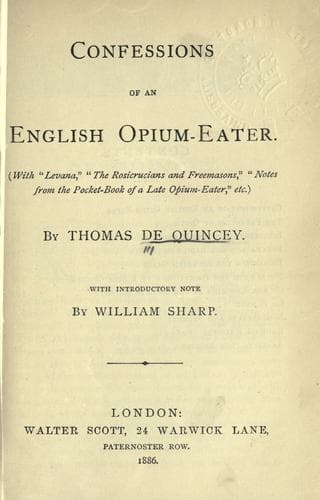
Note Book of an English Opium-EaterDe Quincey, Thomas
Philosophy
Note Book of an English Opium-Eater
De Quincey, Thomas
Opium abuse -- England
price to send him out as a member of council to Bengal, you see clearly
that we could not possibly hang him _before_ we had fulfilled our bargain.
Then it is true we might hang him after he comes back. But, since the man
(being a clever man) has a fair chance in the interim of rising to be
Governor-General, we put it to your candor, Lord Barrington, whether it
would be for the public service to hang his excellency?' In fact, he might
probably have been Governor-General, had his bad temper not overmastered
him. Had he not quarrelled so viciously with Mr. Hastings, it is ten to
one that he might, by playing his cards well, have succeeded him. As it
was, after enjoying an enormous salary, he returned to England--not
Governor-General, certainly, but still in no fear of being hanged. Instead
of hanging him, on second thoughts, Government gave him a red ribbon. He
represented a borough in Parliament. He was an authority upon Indian
affairs. He was caressed by the Whig party. He sat at good men's tables.
He gave for toasts--_Joseph Surface_ sentiments at dinner parties--
'The man that betrays' [something or other]--'the man that sneaks into'
[other men's portfolios, perhaps]--'is'--ay, _what_ is he? Why he is,
perhaps, a Knight of the Bath, has a sumptuous mansion in St. James's
Square, dies full of years and honor, has a pompous funeral, and fears
only some such epitaph as this--'Here lies, in a red ribbon, the man who
built a great prosperity on the basis of a great knavery.' I complain
heavily of Mr. Taylor, the very able unmasker of Junius, for blinking the
whole questions B and C. He it is that has settled the question A, so that
it will never be re-opened by a man of sense. A man who doubts, after
_really_ reading Mr. Taylor's work, is not only a blockhead, but an
irreclaimable blockhead. It is true that several men, among them Lord
Brougham, whom Schlosser (though hating him, and kicking him) cites, still
profess scepticism. But the reason is evident: they have not _read_
the book, they have only heard of it. They are unacquainted with the
strongest arguments, and even with the nature of the evidence. [11] Lord
Brougham, indeed, is generally reputed to have reviewed Mr. Taylor's book.
_That_ may be: it is probable enough: what I am denying is not at all
that Lord Brougham _reviewed_ Mr. Taylor, but that Lord Brougham _read_
Mr. Taylor. And there is not much wonder in _that_, when we see professed
writers on the subject--bulky writers--writers of Answers and Refutations,
dispensing with the whole of Mr. Taylor's book, single paragraphs of which
would have forced them to cancel their own. The possibility of scepticism,
after really _reading_ Mr. Taylor's book, would be the strongest
exemplification upon record of Sancho's proverbial reproach, that a man
'wanted better bread than was made of wheat--' would be the old case
renewed from the scholastic grumblers 'that some men do not know when they
Public-domain text, read in full here on John Shaqi.
Reviews
Reviews
No reviews yet
Be the first to share your thoughts on this work.
Elsewhere in the archive
Join the Discussion
Join the discussion
Sign in to leave a comment or review.
Sign InorCreate an account