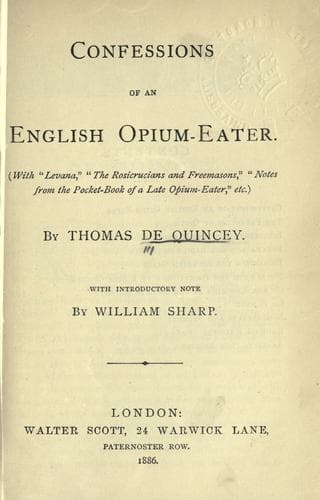
Note Book of an English Opium-EaterDe Quincey, Thomas
Philosophy
Note Book of an English Opium-Eater
De Quincey, Thomas
Opium abuse -- England
But I blame Mr. Taylor heavily for throwing away the whole argument
applicable to B and C; not as any debt that rested particularly upon
_him_ to public justice; but as a debt to the integrity of his own
book. That book is now a fragment; admirable as regards A; but (by
omitting B and C) not sweeping the whole area of the problem. There yet
remains, therefore, the dissatisfaction which is always likely to arise--
not from the smallest _allegatio falsi_, but from the large _suppressio
veri_. B, which, on any other solution than the one I have proposed, is
perfectly unintelligible, now becomes plain enough. To imagine a heavy,
coarse, hard-working government, seriously affected by such a bauble as
_they_ would consider performances on the tight rope of style, is mere
midsummer madness. 'Hold your absurd tongue,' would any of the ministers
have said to a friend descanting on Junius as a powerful artist of style--
'do you dream, dotard, that this baby's rattle is the thing that keeps us
from sleeping? Our eyes are fixed on something else: that fellow, whoever
he is, knows what he ought _not_ to know; he has had his hand in some of
our pockets: he's a good locksmith, is that Junius; and before he reaches
Tyburn, who knows what amount of mischief he may do to self and partners?'
The rumor that ministers were themselves alarmed (which was the naked
truth) travelled downwards; but the _why_ did not travel; and the
innumerable blockheads of lower circles, not understanding the real cause
of fear, sought a false one in the supposed thunderbolts of the rhetoric.
Opera-house thunderbolts they were: and strange it is, that grave men
should fancy newspapers, teeming (as they have always done) with
_Publicolas_, with _Catos_, with _Algernon Sidneys_, able by such trivial
small shot to gain a moment's attention from the potentates of Downing
Street. Those who have despatches to write, councils to attend, and votes
of the Commons to manage, think little of Junius Brutus. A Junius Brutus,
that dares not sign by his own honest name, is presumably skulking from
his creditors. A Timoleon, who hints at assassination in a newspaper, one
may take it for granted, is a manufacturer of begging letters. And it is a
conceivable case that a twenty pound note, enclosed to Timoleon's address,
through the newspaper office, might go far to soothe that great patriot's
feelings, and even to turn aside his avenging dagger. These sort of people
were not the sort to frighten a British Ministry. One laughs at the
probable conversation between an old hunting squire coming up to comfort
the First Lord of the Treasury, on the rumor that he was panic-struck.
'What, surely, my dear old friend, you're not afraid of Timoleon?' First
Lord.--'Yes, I am.' C. Gent.--'What, afraid of an anonymous fellow in the
papers?' F. L.--'Yes, dreadfully.' C. Gent.--'Why, I always understood
that these people were a sort of shams--living in Grub Street--or where
Public-domain text, read in full here on John Shaqi.
Reviews
Reviews
No reviews yet
Be the first to share your thoughts on this work.
Elsewhere in the archive
Join the Discussion
Join the discussion
Sign in to leave a comment or review.
Sign InorCreate an account