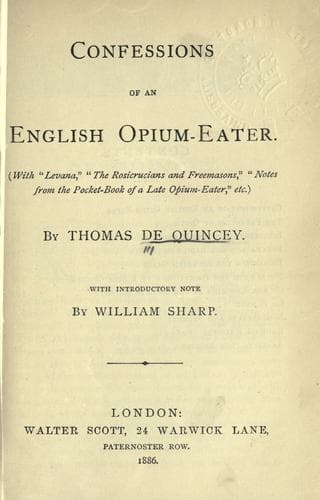
Note Book of an English Opium-EaterDe Quincey, Thomas
Philosophy
Note Book of an English Opium-Eater
De Quincey, Thomas
Opium abuse -- England
was it that Pope used to tell us they lived? Surely you're not afraid of
Timoleon, because some people think he's a patriot?' F. L.--'No, not at
all; but I am afraid because some people think he's a housebreaker!' In
that character only could Timoleon become formidable to a Cabinet
Minister; and in some such character must our friend, Junius Brutus, have
made himself alarming to Government. From the moment that B is properly
explained, it throws light upon C. The Government was alarmed--not at such
moonshine as patriotism, or at a soap-bubble of rhetoric--but because
treachery was lurking amongst their own households: and, if the thing went
on, the consequences might be appalling. But this domestic treachery,
which accounts for B, accounts at the same time for C. The very same
treachery that frightened its objects at the time by the consequences it
might breed, would frighten its author afterwards from claiming its
literary honors by the remembrances it might awaken. The mysterious
disclosures of official secrets, which had once roused so much
consternation within a limited circle, and (like the French affair of the
diamond necklace) had sunk into neglect only when all clue seemed lost for
_perfectly_ unravelling its would revive in all its interest when a
discovery came before the public, viz., a claim on the part of Francis to
have written the famous letters, which must at the same time point a
strong light upon the true origin of the treacherous disclosures. Some
astonishment had always existed as to Francis--how he rose so suddenly
into rank and station: some astonishment always existed as to Junius, how
he should so suddenly have fallen asleep as a writer in the journals. The
coincidence of this sudden and unaccountable silence with the sudden and
unaccountable Indian appointment of Francis; the extraordinary familiarity
of Junius, which had _not altogether escaped notice_, with the secrets of
one particular office, viz., the War Office; the sudden recollection, sure
to flash upon all who remembered Francis, if again he should become
revived into suspicion, that he had held a situation of trust in that
particular War Office; all these little recollections would begin to take
up their places in a connected story: _this_ and _that_, laid together,
would become clear as day-light; and to the keen eyes of still surviving
enemies--Horne Tooke, 'little Chamier,' Ellis, the Fitzroy, Russell, and
Murray houses--the whole progress and catastrophe of the scoundrelism, the
perfidy and the profits of the perfidy, would soon become as intelligible
as any tale of midnight burglary from without, in concert with a wicked
butler within, that was ever sifted by judge and jury at the Old Bailey,
or critically reviewed by Mr. John Ketch at Tyburn.
Public-domain text, read in full here on John Shaqi.
Reviews
Reviews
No reviews yet
Be the first to share your thoughts on this work.
Elsewhere in the archive
Join the Discussion
Join the discussion
Sign in to leave a comment or review.
Sign InorCreate an account