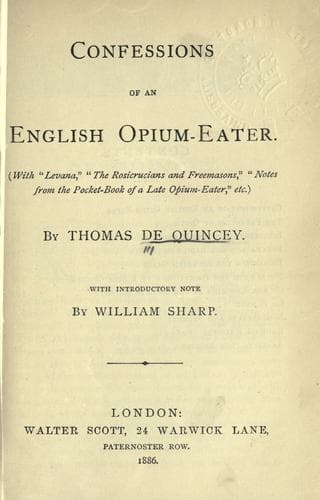
Note Book of an English Opium-EaterDe Quincey, Thomas
Philosophy
Note Book of an English Opium-Eater
De Quincey, Thomas
Opium abuse -- England
I, for my own part, stand upon an isthmus, connecting me, at one terminus,
with the rebels against Greek, and, at the other, with those against whom
they are in rebellion. On the one hand, it seems shocking to me, who am
steeped to the lips in antique prejudices, that Greek, in unlimited
quantities, should not secure a limited privilege of talking nonsense. Is
all reverence extinct for old, and ivy-mantled, and worm-eaten things?
Surely, if your own grandmother lectures on morals, which perhaps now and
then she does, she will command that reverence from you, by means of her
grandmotherhood, which by means of her ethics she might _not_. To be
a good Grecian, is now to be a faded potentate; a sort of phantom Mogul,
sitting at Delhi, with an English sepoy bestriding his shoulders. Matched
against the master of _ologies_, in our days, the most accomplished
of Grecians is becoming what the 'master of sentences' had become long
since, in competition with the political economist. Yet, be assured,
reader, that all the 'ologies' hitherto christened oology, ichthyology,
ornithology, conchology, palaeodontology, &c., do not furnish such mines
of labor as does the Greek language when thoroughly searched. The
'Mithridates' of Adelung, improved by the commentaries of Vater and of
subsequent authors, numbers up about four thousand languages and jargons
on our polyglot earth; not including the chuckling of poultry, nor
caterwauling, nor barking, howling, braying, lowing, nor other respectable
and ancient dialects, that perhaps have their elegant and their vulgar
varieties, as well as prouder forms of communication. But my impression
is, that the Greek, taken by itself, this one exquisite language,
considered as a quarry of _intellectual_ labor, has more work in it,
is more truly a _piece de resistance_, than all the remaining three
thousand nine hundred and ninety-nine, with caterwauling thrown into the
bargain. So far I side with the Grecian, and think that he ought to be
honored with a little genuflexion. Yet, on the other hand, the finest
sound on this earth, and which rises like an orchestra above all the
uproars of earth, and the Babels of earthly languages, is truth--absolute
truth; and the hatefulest is conscious falsehood. Now, there _is_
falsehood, nay (which seems strange), even sycophancy, in the old
undistinguishing homage to all that is called classical. Yet why should
men be sycophants in cases where they _must_ be disinterested? Sycophancy
grows out of fear, or out of mercenary self-interest. But what can there
exist of either pointing to an old Greek poet? Cannot a man give his free
opinion upon Homer, without fearing to be waylaid by his ghost? But it is
not _that_ which startles him from publishing the secret demur which his
heart prompts, upon hearing false praises of a Greek poet, or praises
which, if not false, are extravagant. What he fears, is the scorn of his
contemporaries. Let once a party have formed itself considerable enough to
Public-domain text, read in full here on John Shaqi.
Reviews
Reviews
No reviews yet
Be the first to share your thoughts on this work.
Elsewhere in the archive
Join the Discussion
Join the discussion
Sign in to leave a comment or review.
Sign InorCreate an account