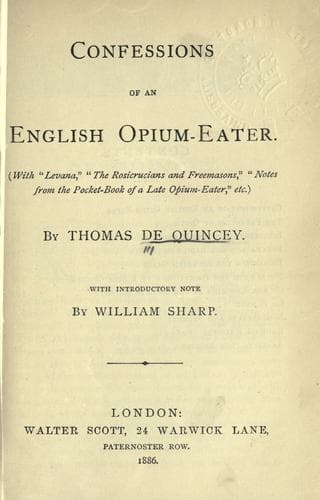
Note Book of an English Opium-EaterDe Quincey, Thomas
Philosophy
Note Book of an English Opium-Eater
De Quincey, Thomas
Opium abuse -- England
protect a man from the charge of presumption in throwing off the yoke of
_servile_ allegiance to all that is called classical,--let it be a party
ever so small numerically, and the rebels will soon be many. What a man
fears is, to affront the whole storm of indignation, real and affected, in
his own solitary person. 'Goth!' 'Vandal!' he hears from every side. Break
that storm by dividing it, and he will face its anger. 'Let me be a Goth,'
he mutters to himself, 'but let me not dishonor myself by affecting an
enthusiasm which my heart rejects!'
Ever since the restoration of letters there has been a cabal, an academic
interest, a factious league amongst universities, and learned bodies, and
individual scholars, for exalting as something superterrestrial, and quite
unapproachable by moderns, the monuments of Greek literature. France, in
the time of Louis XIV., England, in the latter part of that time; in fact,
each country as it grew polished at some cost of strength, carried this
craze to a dangerous excess--dangerous as all things false are dangerous,
and depressing to the aspirations of genius. Boileau, for instance, and
Addison, though neither [2] of them accomplished in scholarship, nor
either of them extensively read in _any_ department of the classic
literature, speak every where of the classics as having notoriously, and
by the general confession of polished nations, carried the functions of
poetry and eloquence to that sort of faultless beauty which probably does
_really_ exist in the Greek sculpture. There are few things perfect
in this world of frailty. Even lightning is sometimes a failure: Niagara
has horrible faults; and Mont Blanc might be improved by a century of
chiselling from judicious artists. Such are the works of blind elements,
which (poor things!) cannot improve by experience. As to man who
_does_, the sculpture of the Greeks in their marbles and sometimes in
their gems, seems the only act of _his_ workmanship which has hit the
bull's eye in the target at which we are all aiming. Not so, with
permission from Messrs. Boileau and Addison, the Greek literature. The
faults in this are often conspicuous; nor are they likely to be hidden for
the coming century, as they have been for the three last. The idolatry
will be shaken: as _idols_, some of the classic models are destined
to totter: and I foresee, without gifts of prophecy, that many laborers
will soon be in this field--many idoloclasts, who will expose the signs of
disease, which zealots had interpreted as power; and of weakness, which is
not the less real because scholars had fancied it health, nor the less
injurious to the total effect because it was inevitable under the
accidents of the Grecian position.
Public-domain text, read in full here on John Shaqi.
Reviews
Reviews
No reviews yet
Be the first to share your thoughts on this work.
Elsewhere in the archive
Join the Discussion
Join the discussion
Sign in to leave a comment or review.
Sign InorCreate an account