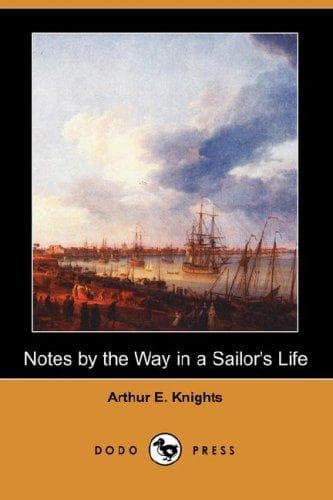
Notes By the Way in a Sailor's LifeKnights, Arthur E.
History
Notes By the Way in a Sailor's Life
Knights, Arthur E.
Knights, Arthur E.; Sailors -- England -- Biography; Seafaring life
Whilst running to Hankow with the steamer "Neimen" I had as sailors
Malays. The firemen were seedy boys, or Nubians. The steward was a Goa
Portuguese. The servants were Chinese, and the cook a Chinese who
claimed to be an American, he having been trained by Captain John
Parrott, of San Francisco, "a number one American man," who had taught
him to swear quite neatly.
Well, on Christmas Day, 1862, we had a very hard gale and snowstorm, and
early in the evening we had to anchor. Then we sat down to dinner, which
we hoped to enjoy. There were several passengers on board, and when the
soup was served and tasted each looked at the other, and I looked at the
steward and asked him what kind of soup it was. He said it was plain
soup. I asked why some meat had not been used in its making, and he
replied that the cook must have eaten the meat, as he was given plenty.
The cook was sent for, and when he was confronted with the steward he
began to use the refined language taught him by Captain Parrott. I
ordered the steward to put all the soup back into the tureen. Then I
invited the cook to take a seat at the table and consume the soup, which
he did. When he had taken it he rose and, bowing most politely, tucked
the tureen under his arm like an admiral with his cocked hat, and said,
"Excusey, my sir; all hab finishee," and backed out of the saloon most
politely.
A Brazilian Slaver.
In the year 1851 I was on a voyage to Melbourne, Australia, on the
sailing ship "Severn." This was shortly after the opening of the gold
mines. We left Southampton with about one hundred passengers, and had a
very fine run with fair weather. There was no incident to mar the
enjoyment of the trip until we neared the coast of Brazil, when one
morning we saw a smart-looking brig hove to, waiting for us to come up,
and when we came near our passengers became very much excited, as we
could see there was an unusual number of men on her deck; the idea was
that it was a pirate vessel.
When we came very near to her, a boat was put off from her, and an
officer brought a letter from her captain asking for provisions and
water, saying that the vessel was bound for the port of Santos, and had
been blown off the coast in a pampero. Neither the officer nor the
boat's crew could or would speak English. They could only ask in Spanish
for "tabac." Some of our sailors protested that they were either British
or--Americans. Well, they were supplied with salt beef and pork, canned
meats, water, etc. Several trips were made by the boat, and when all was
finished, and the boat was at some distance from us, these marauders
stood up and gave us three rousing cheers in good plain English, and
called out "Good-bye boys, and good luck to you for feeding the
blackbirds." The brig was full of slaves.
Public-domain text, read in full here on John Shaqi.
Reviews
Reviews
No reviews yet
Be the first to share your thoughts on this work.
Join the Discussion
Join the discussion
Sign in to leave a comment or review.
Sign InorCreate an account