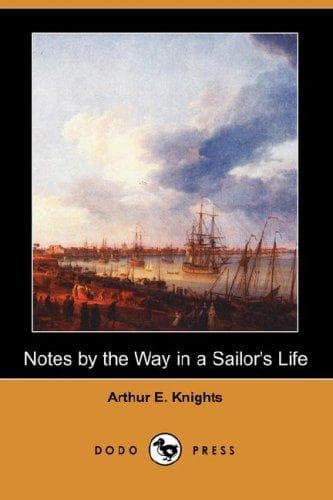
Notes By the Way in a Sailor's LifeKnights, Arthur E.
History
Notes By the Way in a Sailor's Life
Knights, Arthur E.
Knights, Arthur E.; Sailors -- England -- Biography; Seafaring life
"No," said he; "I am an ex-Danish naval officer, and all my officers are
Danes, and we have German cadets. There being no German navy, there are
no officers yet trained."
Business then began, and the transfer of provisions and stores of almost
every kind was made from one ship to the other. After this we used to
have daily friendly intercourse for about three weeks, and one fine
morning the "Hertha" left her anchorage. A fresh easterly breeze was
blowing, and the "Hertha" was working under sail against the wind, which
was increasing, and a nasty, short sea rising. After a couple of hours
we saw her yards squared, and the vessel put back and she anchored near
to us. In the afternoon, the wind having moderated, an officer from her
came to buy a grindstone.
This caused some little merriment. Then the officer explained that in
the forenoon, when beating down the gulf, in one of the plunges, the
grindstone had been washed off the forecastle-head, where the men had
been employed in grinding their cutlasses.
They were expecting to hear news of a rupture between France and
Germany, and they were on the way to Hongkong for shelter.
It is highly creditable to the Germans that from so humble a beginning
they have raised such a fine fleet as they now possess.
After our return to Shanghai from Taku I was permitted to leave the
"Ballaarat" and take command of the "Neimen" on the Yangtse.
An Incident in Hongkong Harbour.
The following incident regarding Captain Keppel may be of some interest
to sailors, and perhaps is remembered by some residents of Hongkong who
may have been there at the time of the last war with China.
Sir Harry Keppel was every inch a sailor, and sometimes did some very
strange things, which would annoy his superiors; but the very oddity of
his actions gained the hearts and confidence of those who served under
him, and he could rely on every one acting as one machine when he
commanded.
One day, for some reason, the Admiral, Sir Michael Seymour, who was then
on the flagship "Calcutta," gave orders for the "Raleigh" to proceed to
sea in face of a very strong southwest monsoon. The "Raleigh" was to go
out by the Lyemoon and return by Green Island. The ship was got under
way, and went out in the ordinary way by the Lyemoon, and beat round the
island. After some hours she came back by way of Green Island, with all
plain sails and all studding-sails set. At first this called for no
special attention, except for the grand sight of a man-of-war under full
sail.
Public-domain text, read in full here on John Shaqi.
Reviews
Reviews
No reviews yet
Be the first to share your thoughts on this work.
Join the Discussion
Join the discussion
Sign in to leave a comment or review.
Sign InorCreate an account