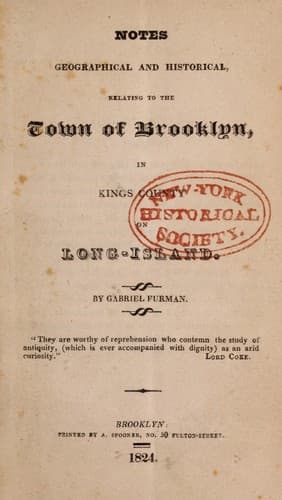
Notes Geographical and Historical, Relating to the Town of Brooklyn in Kings County on Long-Island — John Shaqi
Notes Geographical and Historical, Relating to the Town of Brooklyn in Kings County on Long-IslandFurman, Gabriel
History
Notes Geographical and Historical, Relating to the Town of Brooklyn in Kings County on Long-Island
Furman, Gabriel
Brooklyn (New York, N.Y.) -- History
The soil of this town appears to be mostly alluvial, though some few
primitive rocks are to be met with. Several years since, in digging a
well on some of the highest ground in Brooklyn, a hemlock board was
found at the depth of 30 feet, and again at the depth of 73 feet, oyster
and clam shells were met with, which crumbled on being exposed to the
air.
The shores of Brooklyn, where they are not defended by wharves, are
undergoing continual and rapid changes, in consequence of the velocity
of the current in the East River. The tide rises here about 5 feet.
There is very little doubt, but that Governor’s Island was formerly
connected with Red Hook point in this town. It is an established fact,
that previous to the Revolutionary contest, cattle were driven from Red
Hook to Governor’s Island, which places at that time were only separated
by a very narrow channel, which is called Buttermilk channel, and is now
wide and deep enough to admit of the largest size of merchant vessels
passing through.
The climate is very changeable, but cannot be called unhealthy. People
in this town live to as great age, as in almost any other part of the
United States; as instances of which, April, 1823, Mr. Tiebout died in
this town, aged 100 years and 10 months. The same year, Mr. Schoonmaker
died, aged 84 years; and in 1824, Mary Peterson, a colored woman died,
aged 103 years. It is not an uncommon thing for the inhabitants to live
beyond the “three score years and ten.”
This town has at different periods been visited by the yellow fever.
Between July 10th and September 10th, 1809, 28 persons died of that
disease.--During the prevalence of the yellow fever in the city of
New-York, in the summer of 1822, seven persons died of that disease in
Brooklyn. In the summer of 1823, the yellow fever made its appearance in
the village of Brooklyn, and nine persons fell victims to that dreadful
pestilence, in the space of one month, during which time its ravages
continued. Every year that this disease made its appearance amongst us,
it could be distinctly traced to some foreign cause; as, in 1809, it was
brought in the ship Concordia, Captain Coffin, on board of which vessel
the first case and death happened. In 1822, it was introduced from the
city of New-York--and in 1823, it was traced to two or three vessels
which had arrived a short time previous from southern latitudes. Indeed
the high and airy situation of Brooklyn almost precludes the idea of its
being engendered among us.
ANCIENT GRANTS AND PATENTS.
In the year 1638, William Kieft, Director General and Counsellor for
their high mightinesses the States General, and his highness the Prince
of Orange, granted to Abraham Rycken, a tract of land in the present
town of Brooklyn.
Public-domain text, read in full here on John Shaqi.
Reviews
Reviews
No reviews yet
Be the first to share your thoughts on this work.
Join the Discussion
Join the discussion
Sign in to leave a comment or review.
Sign InorCreate an account