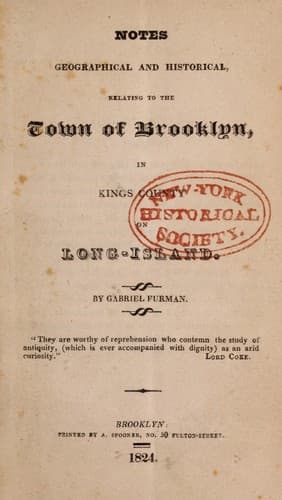
Notes Geographical and Historical, Relating to the Town of Brooklyn in Kings County on Long-IslandFurman, Gabriel
History
Notes Geographical and Historical, Relating to the Town of Brooklyn in Kings County on Long-Island
Furman, Gabriel
Brooklyn (New York, N.Y.) -- History
“Whereas you are chosen and appointed an Overseer for the Towne of
Breucklen you doe sweare by the Ever-living God, that you will
faithfully and diligently discharge the trust reposed in you, in
relation to the publique and towne affaires, according to the
present lawes established, without favour, affection or partiality
to any person or cause which shall fall under your cognizance; and
at time when you shall bee required by your superiors to attend the
private differences of neighbours, you will endeavour to reconcile
them: and in all causes conscientiously and according to the best
of your judgment deliver your voyce in the towne meetings of
Constable and Overseers. So helpe you God.” These officers were
commonly sworn by the Court of Sessions; but in the year 1671, the
Constable of Newtown objected to the Court’s swearing the overseers
of that town, “alledginge that accordinge to the amendments of the
law iff special occation required, itt is in the power of the
Constable to sweare them, otherwise not, which is left to his Honor
the Governor to decide.” The inhabitants of the town for which the
overseers were elected were authorised to determine by a major vote
whether the said overseers should, on admission to office, take the
oath prescribed as above; and in case the said overseers were not
sworn, it was a legal objection against their proceedings on the
part of any person prosecuted in their court, unless the overseers
immediately on objection being made, took the oath, which the
Constable was permitted to administer.
It was the duty of the overseers, together with the Constable, to
hold Town Courts, for the trial of causes under £5. Their other
duties are contained in the following summary. On the death of any
person, they were to repair with the Constable, to the house of the
deceased, and inquire after the manner of his death, and of his
will and testament; and if no will was found, the Constable in the
presence of the Overseers was, within 48 hours, to search after the
estate of the deceased, and to deliver an account of the same in
writing, under oath, to the next Justice of the Peace. They,
together with the Constable made all assessments. If any Overseer
died during his term, the rest of the Overseers by a major vote,
made choice of another in his place; and if the person so chosen
refused to serve, he forfeited the sum of £10, towards defraying
the town charges. They were to settle the bounds of the town,
within twelve months after the bounds were granted. They had the
power of regulating fences. They were authorised together with the
Constable to make choice of two out of the eight overseers of
Church affairs.
Public-domain text, read in full here on John Shaqi.
Reviews
Reviews
No reviews yet
Be the first to share your thoughts on this work.
Join the Discussion
Join the discussion
Sign in to leave a comment or review.
Sign InorCreate an account