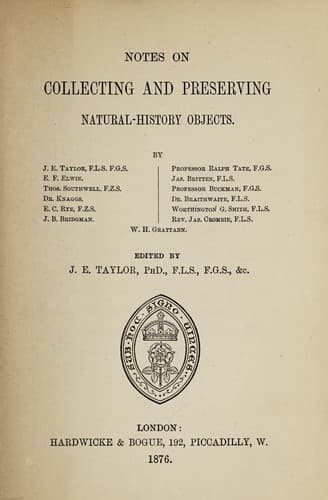
Notes on Collecting and Preserving Natural-History Objects
Science
Notes on Collecting and Preserving Natural-History Objects
Botanical specimens -- Collection and preservation; Zoological specimens -- Collection and preservation
In Mr. Chivers's note on Preserving Animals, No. 117 of
'Science-Gossip,' the following passage occurs:--"The skeleton must
be put in an airy place to dry, but not in the sun or near the fire,
as that will turn the bones a bad colour." I cannot comprehend how
this idea should have arisen. Perhaps the most indispensable assistant
to the skeleton preparer is that very sun which Mr. Chivers warns
him against. The bleaching power of the rays of a hot summer sun is
astounding, and bones of the most inferior colour can rapidly be turned
to a beautiful white by this means. It is for want of time and care in
following out this method that the professional skeleton preparers in
London resort to the aid of lime, which, although it makes them white,
is terribly detrimental to the bones themselves. In a smoky city like
London, the principle of sun-bleaching would be hard to follow; but so
great is its value, that more than once I have had valuable specimens
sent down to me in the country, by a comparative anatomist in London,
to undergo a course of sun-bleaching; and a specimen which I have
received stained and blotched, I have returned of a beautiful uniform
white, a change entirely due to that sun which we are told to beware of.
The question, How are skeletons to be prepared? is one which is
repeatedly asked. People desire a method by which with little trouble
the flesh may be removed from a specimen, and a beautiful skeleton of
ivory whiteness left standing in its natural position. I can assure all
such inquirers that this cannot be accomplished by any method at all.
The art of preparing bones is a long, elaborate, and difficult one, and
he who wishes to become a proficient in it must be alike regardless to
the most unpleasant odours, and to handling the most repulsive objects.
Mr. Chivers's receipt for the maceration of specimens is about the best
which one could have, only I should not advise so frequent a change
of the water. What is needed is as rapid a decomposition of the flesh
as is possible, and then the cleaning of the skeleton just before the
harder ligaments have also dissolved. But this requires very careful
watching, and with the utmost pains it is almost impossible to get a
skeleton entirely connected by its own ligaments.
Public-domain text, read in full here on John Shaqi.
Reviews
Reviews
No reviews yet
Be the first to share your thoughts on this work.
Join the Discussion
Join the discussion
Sign in to leave a comment or review.
Sign InorCreate an account