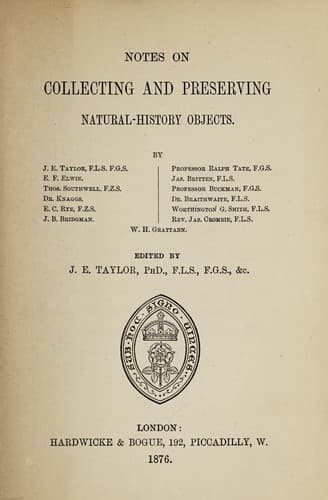
Notes on Collecting and Preserving Natural-History Objects
Science
Notes on Collecting and Preserving Natural-History Objects
Botanical specimens -- Collection and preservation; Zoological specimens -- Collection and preservation
Between the true naturalist and the mere "collector" there is a wide
gap, and I trust that none for whom I am writing will allow themselves
to drift into the latter class; the incalculable mischief wrought by
those who assist in the extermination of rare and local species by
buying up every egg of a certain species which can be obtained, for
the mere purpose of exchange, cannot be too much deprecated, and I
hope that none of my readers will be so guilty; to them the pleasures
of watching the nesting habits of the bird, the diligent search and
the successful find are unknown; the eggs in such a cabinet are mere
egg-shells, and not objects pregnant with interest, recalling many a
happy ramble, and many a hardly-earned reward in the discovery of facts
and habits before unknown. Every naturalist must be more or less a
collector, but the naturalist should always be careful of drifting into
the collector, his note-book and his telescope should be his constant
and harmless companions.
When the writer first commenced his collection, the mode of preparing
the specimens for the cabinet was very rude indeed, and the method of
arranging equally bad; he is sorry to say the popular books upon the
subject which he has seen do not present any very great improvement; in
giving the results of his own experience, and the plan pursued by the
most distinguished oologists of the day, who have kindly allowed him to
explain the methods they adopt, he will, he trusts, save not only much
useless labour, but many valuable specimens.
Before saying a word as to preparing specimens for the cabinet, I wish
to impress upon the young oologist the absolute necessity for using
the greatest care and diligence in order satisfactorily to identify,
beyond possibility of doubt, every specimen, before he admits it to
his collection. Without such precautions, what might otherwise be
a valuable collection is absolutely worthless; and it is better to
have a small collection of authentic specimens than a much larger
one, the history of which is not perfectly satisfactory; in fact, it
is a good rule to banish from the cabinet every egg which is open
to the slightest doubt. There are some eggs which, when mixed, the
most experienced oologist will find it impossible to separate with
certainty, and which cannot be identified when once they are removed
from the nest.
Public-domain text, read in full here on John Shaqi.
Reviews
Reviews
No reviews yet
Be the first to share your thoughts on this work.
Join the Discussion
Join the discussion
Sign in to leave a comment or review.
Sign InorCreate an account