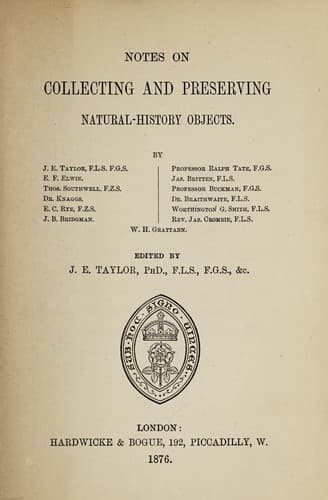
Notes on Collecting and Preserving Natural-History Objects
Science
Notes on Collecting and Preserving Natural-History Objects
Botanical specimens -- Collection and preservation; Zoological specimens -- Collection and preservation
by whom taken (if not by myself), or how it came into my possession,
with any other particular worthy of note. With all eggs received in
exchange or otherwise, this note should, if possible, be obtained in
the handwriting of the person from whom they are received, and the
slip on which it is written be affixed in the book under the number.
When specimens of the eggs of the same species are obtained from
various localities, those from each locality should be distinguished by
a letter prefixed to the number. The plan will be better understood by
referring to the following extract:
62. Great Sedge-warbler (_Sylvia turtoides_, Meyer).
62. Received of ----, from the cabinet of Mr. ----.
a62. Taken by ----, a servant of ----, on the banks of the river
Tougreep, near Valkenswaard, in the south of Holland,
on the 9th of June, 1855. The birds may be heard a long
way off by their incessant "Kara, Kara, Kara." A few
years ago not one was to be found near Valkenswaard.
A. B----
b62. Bought at Antwerp in August, 1865. X/
* * * * *
118. Mealy Red-pole (_Fringilla borealis_, Tem.).
118. Nyborg, at the head of Mæsk Fjord (one of the two
branches into which Varanger Fjord divides), East
Finmark, Norway, July, 1855. The birds were very
plentiful, and only one species seen, which appears
quite identical with that which visits England every
winter.
C. D. E----
By means of these entries, and the corresponding number on the egg,
mistakes are impossible, and the name and history of each egg would be
quite as well known to a stranger as to the possessor. It needs not to
be said that this catalogue is replete with the deepest interest to
its compiler. In it he sees the record of many a holiday trip and many
a successful find. Some of the entries in my own register--the earliest
date back five-and-twenty years--are memorials of companions long since
dead, or separated by rolling oceans, but on whose early friendship it
is a pleasure to dwell.
Nothing can be more vexatious and disappointing than the receipt of a
box of valuable eggs in a smashed or injured condition from want of
care or knowledge of the proper method of packing. A simple method
is recommended by Professor Newton, which, from experience, I can
confidently recommend:--Roll each egg in tow, wool, or some elastic
material, and pack them closely in a stout box, leaving no vacant
place for them to shake; or a layer of soft material may be placed at
the bottom of the box, and upon it a layer of eggs, each one wrapped
loosely in old newspaper; upon this another layer of wool or moss, then
again eggs, and packing alternately until the box is quite full. Bran,
sawdust, &c., should never be used; and it should be ascertained that
the box is quite filled, so that no shaking or settlement can occur.
Public-domain text, read in full here on John Shaqi.
Reviews
Reviews
No reviews yet
Be the first to share your thoughts on this work.
Join the Discussion
Join the discussion
Sign in to leave a comment or review.
Sign InorCreate an account