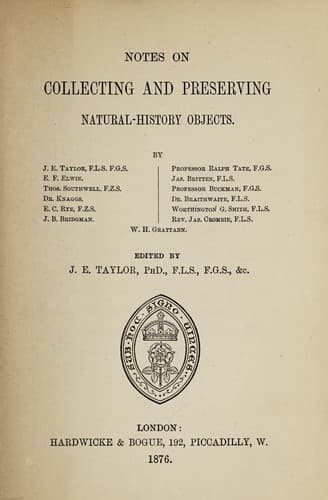
Notes on Collecting and Preserving Natural-History Objects — John Shaqi
Notes on Collecting and Preserving Natural-History Objects
Science
Notes on Collecting and Preserving Natural-History Objects
Botanical specimens -- Collection and preservation; Zoological specimens -- Collection and preservation
At rest on stems of grasses and other plants butterflies may be taken
on dull, sunless days; but it requires some experience to detect a
butterfly with its wings raised up over its back: the little "Blues"
may thus be freely boxed in their localities. Again, such butterflies
as hybernate may be found in old sheds and outhouses, or under stacks.
Moths may be taken at rest on tree trunks, palings, and walls, or
amongst foliage and ground herbage. Some species are to be freely
captured in this way after their evening flight is over. Of course, for
evening work, a lantern to assist our vision will be indispensable.
On the wing, some butterflies are exceedingly active, others
comparatively sluggish; some fly high, others low. In hunting them, the
chief points to be remembered are not to alarm, but rather cautiously
to stalk our game, and strike, when we have an opportunity, with
precision. It is important also to avoid throwing a shadow over them,
and it is a good plan to get to windward of them--anything like flurry
will be fatal to success.
Moths which fly by day may be chased in the same manner, but some
may be observed disporting themselves round trees; these must be
watched, and netted as they now and then descend. Others fly at a
very low altitude, and are only brought into the field of vision by
our assumption of the recumbent position. At night again, though we
watch for anything stirring the air, among the trees or the herbage,
our tactics are somewhat modified; for, if the insect be of whitish
colour, we should so place ourselves that its form will stand boldly
out against a mass of dark foliage, whereas, if it be dingy in hue, we
must take the sky for our background.
Disturbing insects, and thus causing them to start forth, and so render
themselves visible, is another method of collecting. This is carried
out in various ways.
First, the occupants of high trees may be expelled by jarring the
trunk with a heavily loaded mallet, or by thwacking the trunk with a
long hazel stick; but a sharp look-out must be kept, for some sham
death, and fall plump down, while others make off as fast as they can.
Other plans are to pelt the trees with stones, or pump on them with a
powerful garden engine, or beat them with a long pole; and of all tress
the most profitable for this purpose is the yew; though firs, oaks,
beeches, and other trees are not to be despised.
For beating bushes there is nothing better than a walking-stick, and
for low herbage a long switch passed quickly from side to side with a
tapping movement is best adapted. The tenants of tree trunks may be
disturbed by brushing the surface with a leafy little bough, or, better
still, by the use of a strong fan, with which a powerful blast may be
driven, the net being held in such a position as to intercept such
insects as are blown off.
Public-domain text, read in full here on John Shaqi.
Reviews
Reviews
No reviews yet
Be the first to share your thoughts on this work.
Join the Discussion
Join the discussion
Sign in to leave a comment or review.
Sign InorCreate an account