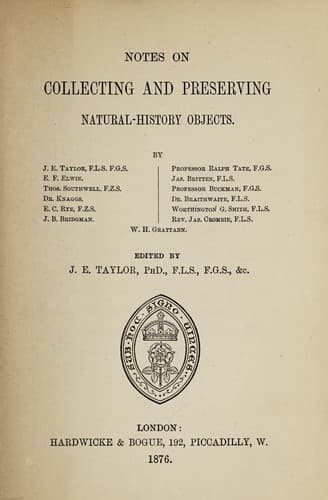
Notes on Collecting and Preserving Natural-History Objects
Science
Notes on Collecting and Preserving Natural-History Objects
Botanical specimens -- Collection and preservation; Zoological specimens -- Collection and preservation
For water beetles, a similar net to that last mentioned is effective,
but it should be stouter and with a flat front, for dredging closely
against the sides and bottoms of ponds. The best substance for its
bag is fine sampler canvas; and a very large, stout bamboo cane is at
once light and strong for its stick. To avoid friction the bag may be
affixed to small wire rings let into holes on the lower edge of the
frame, or running on the frame itself.
A sieve is one of the most remunerative implements, and may be procured
either simple or folding. It consists of a stout wire-framed circle,
connected by a strong linen band, six inches deep, with the bottom of
an ordinary wire sieve, the meshes of which are wide enough to allow
any beetle to pass through. Leaves, grass, flood refuse, ants' nests
materials, cut grass, seaweed, haystack and other _débris_, are roughly
shaken in this over a sheet of brown paper, which should invariably
form part of a Coleopterist's apparatus. A stout piece of double
waterproof material may be substituted; and, in marsh collecting, must
be used as a kneeling pad.
For ordinary bark collecting, a strong ripping chisel (of which the
blade is well collared, so as not to slip) is as useful a tool as
can be procured; but for _real_ tree working, no ordinarily portable
instrument is thoroughly effective. Light steel hammers with a lever
spike may delude the collector; but a woodman's axe, a saw, a pickaxe
or crowbar, will often be found not too strong. For cutting tufts,
&c., a strong garden pruning-knife is good, and an old fixed-handled
dinner-knife (carried in a sheath) better. For holding the results of
the operation of these instruments, the collector needs but one or two
collecting bottles--one rather small and circular, of as clear and
strong glass (_not_ cast) as can be got, with a wide mouth and flat
bottom. Its neck should not slope, but be of even width, or the cork
will often get out of itself. This cork should be a deep one, and
be perforated longitudinally by a stout and large round quill, the
bottom of which should be level with the bottom of the cork, the top
projecting some inch and a half, with the upper orifice not cut off
straight, but slightly sloped diagonally, so as more easily to scoop
up beetles from the net or hand. It is closed with an _accurately
fitting_, soft, wooden plug, rather longer than the quill, reaching
exactly to the bottom of it, but with its top projecting above the top
of the quill, and broader than it, so as to be easily pulled out by
the teeth when the hands are occupied. The bottle should be secured
by stout twine to the buttonhole, enough play being left for it to
reach the net in any ordinary position. I usually secure the external
junction of quill and cork with red sealing-wax, and have more than
once found the bright red catch my eye when I have lost my bottle.
[N.B. This loss will always happen to every collector; generally after
Public-domain text, read in full here on John Shaqi.
Reviews
Reviews
No reviews yet
Be the first to share your thoughts on this work.
Join the Discussion
Join the discussion
Sign in to leave a comment or review.
Sign InorCreate an account