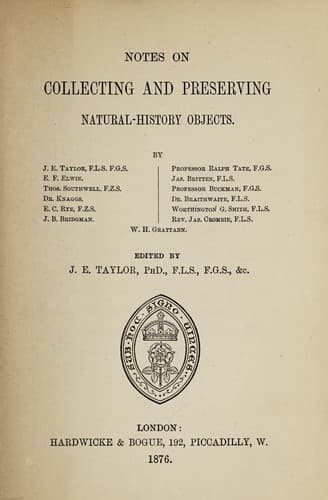
Notes on Collecting and Preserving Natural-History Objects
Science
Notes on Collecting and Preserving Natural-History Objects
Botanical specimens -- Collection and preservation; Zoological specimens -- Collection and preservation
Species of moderate size, say up to that of an ordinary _Harpalus_, are
in this country usually mounted on card. Much is to be said both for
and against this practice: it enables the proportions and formation of
limbs to be well appreciated, and it preserves the specimens securely;
but there can be no doubt that it prevents an inspection of the under
side, except at the slight trouble of extra manipulation in floating
off in cold water and reversing, and that the gum used clogs the
smaller portions of the insect that come in contact with it. Specimens
larger than those mentioned should be pinned through the centre of
the upper third of the right wing-case (never through the scutellum
or thorax), and the limbs extended in position with pins on a setting
board, made of a flat strip of cork glued on deal. Both these and the
mounted examples must be left to dry, for a week at least, in the open
air: if the boards are fitted in a frame, they can be reversed (as soon
as the gum is dry in mounted specimens), so that the specimens are
bottom upwards--dust cannot then collect on them, and there is less
chance of mites attacking them. Specimens dry more rapidly in spring
and summer than at any other time, and of course more readily in dry
weather.
For mounting specimens, five or six small pieces of the finest and
most transparent gum tragacanth, or "gum dragon," with rather less
than the same number of pieces of clear gum arabic, are to be put in
a wide-mouthed bottle with about a large wine-glassful of cold water.
In a short time (twenty-four hours at most) the gum absorbs the fluid
and swells; then add half as much more water, and stir the mixture,
which, on being left for another twenty-four hours at most, will be
ready for use. The mixture should be dull white, of even texture,
and not quite fluid. Never make a large quantity at one time, or be
persuaded to put _anything_ else into it. Card for mounting should be
the whitest, smoothest, and best that can be procured. "Four-sheet
Bristol board" for large specimens, and three-sheet for ordinary use,
are about the proper degrees of thickness. Robersons, of Long Acre,
artists' colourmen, have promised the writer to turn out cardboard of
this kind with an extra milling, to ensure a good surface. Upon strips
of this card, pinned on a setting board, the insects to be set out are
mounted, one at a time, and not too close to each other, each on a
separate "dab" of the gum, the limbs being duly set out with a fine pin
or needle mounted in a paint-brush stick. A pin with the point very
finely turned, so as to form a minute hook, is very useful; and for
extremely minute work a "bead-needle" is valuable. The gum-brush should
not be used in setting, but one or two very fine-pointed camel's-hair
brushes may be found of advantage. Before mounting, reverse the
specimen on the blotting-paper, and brush out its limbs as far as
practicable with a damp flat brush. Very refractory individuals may
Public-domain text, read in full here on John Shaqi.
Reviews
Reviews
No reviews yet
Be the first to share your thoughts on this work.
Join the Discussion
Join the discussion
Sign in to leave a comment or review.
Sign InorCreate an account