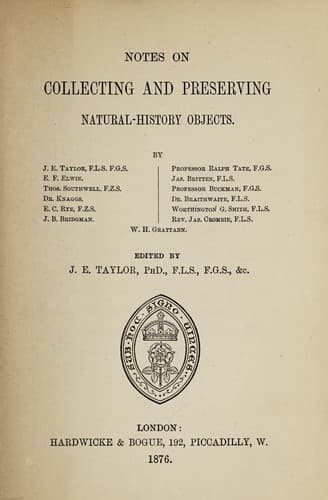
Notes on Collecting and Preserving Natural-History Objects — John Shaqi
Notes on Collecting and Preserving Natural-History Objects
Science
Notes on Collecting and Preserving Natural-History Objects
Botanical specimens -- Collection and preservation; Zoological specimens -- Collection and preservation
Specimens will occasionally become discoloured with grease, usually
from defective drying, though many water beetles and internal feeders,
and most autumn-caught specimens, are specially liable to this defect.
Benzine is an effectual remedy for it and for mites, and can be
liberally applied with a brush. Carbolic or phænic acid, dissolved in
that fluid (or alone, see p. 64), is an effectual safeguard against
mould from damp; and when in solution with water, this acid has been
found useful as a wash for card and boxes, which then are not attacked
by mites. To re-card a specimen that has become discoloured (whether
from either of these causes, or from age), it is only necessary that
it should be floated in cold water for a few minutes; the insect can
then be dried, well saturated with benzine, and again mounted, looking
as fresh as ever. But, in re-carding specimens, it is necessary to be
very careful with such as were originally kept too long in a laurel or
cyanide bottle, as they are apt to become so rotten that a little damp
will cause a "solution of continuity."
As to storing the specimens when quite dry, I can add nothing to the
excellent observations of Dr. Knaggs, at p. 65; the same remarks
applying with equal force to _Coleoptera_; except, perhaps, that, even
when the collector has (and is satisfied with) a cabinet, he is likely,
in proportion to the _real_ work done by him, to establish type-boxes
of all the difficult groups.
For the examination of insects, readily manipulated by being pinned
singly on a square, flat, thick piece of cork or bung, a pocket
glass is, of course, necessary. In this case, the best instrument is
the cheapest in the long run, whatever its cost; and one by a good
maker, such as Ross, with modifications of four powers, will suffice
for any ordinary work. For very small species, a Coddington, of the
clearest definition and highest power attainable, is of immense help.
But when the collector finds that he needs a compound microscope
to separate species, it is the firm opinion of the present writer
that that collector had better take to some other pursuit than
studying _Coleoptera_. To anyone, however, whose researches entail an
examination of the minute cibarian and other organs of beetles, whether
for purposes of classification or otherwise, the compound is absolutely
necessary; though even then the lower powers are usually sufficient.
For rough dissection, all that is needed are an oculist's very small
lance-headed dissecting-knife and a stout and fine needle. With these,
under a lens mounted on a little stage to allow the free use of both
hands, much may be done. The writer, however, has seen and used a very
pretty (and comparatively inexpensive) dissecting-stand, with various
powers and much latitude of motion, by Ross.
Public-domain text, read in full here on John Shaqi.
Reviews
Reviews
No reviews yet
Be the first to share your thoughts on this work.
Join the Discussion
Join the discussion
Sign in to leave a comment or review.
Sign InorCreate an account