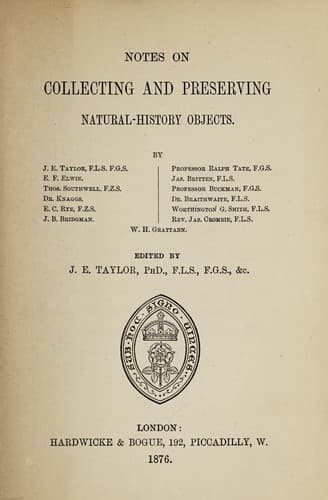
Notes on Collecting and Preserving Natural-History Objects — John Shaqi
Notes on Collecting and Preserving Natural-History Objects
Science
Notes on Collecting and Preserving Natural-History Objects
Botanical specimens -- Collection and preservation; Zoological specimens -- Collection and preservation
We have seen a good many converts made to geology in a similar manner,
since first we laid open to the light this silent memorial of ages
which have passed away. Let a man have ever so slight acquaintance with
geology, and give him the chance of hammering out a fossil for himself,
and the odds are you thereby make him a geologist for life. There is
something almost romantic in the idea that you are looking for the
first time, and have yourself disentombed the remains of creatures
which probably lived scores of millions of years ago! We would strongly
advise our readers, therefore, not to fall into the error of supposing
that fossil-hunting belongs to highly-trained geologists. On the
contrary, it is by fossil-hunting alone that you can ever hope to be a
geologist yourself. Another mistake often made, is that of supposing
these rich and interesting geological localities are at a distance.
It seems so hard to suppose, after reading about typical sections,
&c., that under your very feet, in the fields where you have so often
played, there occur geological phenomena of no less interest. But it
is actually surprising what evidences of our earth's great antiquity,
in the shape of fossils, &c., may be studied and obtained in the most
out-of-the-way and insignificant places.
You say you have no _rocks_ in your neighbourhood--nothing but barren
sands, or beds of brick-earth or clay. Well, go to some section of
the latter, exposed, perhaps, in some tarn or stagnant pond in a
turnip-field. You examine the sides, and what do you see? Nothing, but
here and there a boulder-stone sticking out. Well, be content with
that. You said you had no rocks in your neighbourhood; how, then, has
that boulder, which is a rounded fragment of a rock broken off from
somewhere--how has it come there? Here is a poser at once. Examine
it, and you will perhaps see that its hard surface is polished or
scratched, and then you remember the theory of icebergs, and feel
astonished to think that you hold in your hand an undeniable proof
of the truth of that theory. Those very scratchings could have been
produced in no other way; that foreign fragment of a rock now only to
be found on some distant mountain-side could have been conveyed in no
other manner. Not content with the exterior examination, you break
the boulder-stone open, when you may chance to find it is a portion
of silurian, carboniferous or oolitic limestone, and that it contains
_fossils_ belonging to one of those formations. Here is a find--an
object with a double interest turning up where you never expected
to discover the slightest geological incident! You examine other
boulders, and find in them general evidences of ice-action in their
present re-deposition, and most instructive lessons as to the nature of
rocks of various formations, from the granite and trap series to the
fossiliferous deposits. In fact, there is no place like one of these
old boulder-pits for making oneself acquainted with petrology, or the
Public-domain text, read in full here on John Shaqi.
Reviews
Reviews
No reviews yet
Be the first to share your thoughts on this work.
Join the Discussion
Join the discussion
Sign in to leave a comment or review.
Sign InorCreate an account