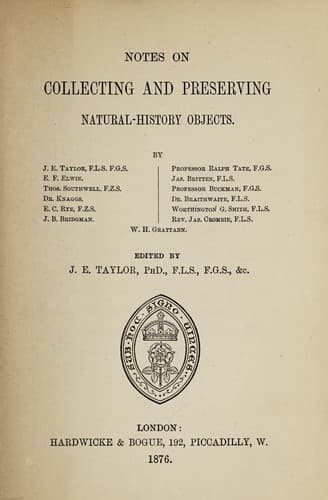
Notes on Collecting and Preserving Natural-History Objects
Science
Notes on Collecting and Preserving Natural-History Objects
Botanical specimens -- Collection and preservation; Zoological specimens -- Collection and preservation
The string will be found useful for tying up the larger
Polyporei; these are frequently of great size, and often weigh many
pounds. In collecting, all Agarics should be kept separate as much as
possible; for this purpose thin paper, such as is used by stationers
and milliners, is indispensable; every specimen should be wrapped very
lightly in a piece of thin paper before boxing, as the elasticity of
the paper not only prevents breaking and bruising, but it also prevents
the spores of one species being scattered over another. In carrying
fungi about, or sending fresh specimens from one place to another,
nothing is so good as this thin paper interspersed here and there with
fronds of the common bracken. Sawdust, hay, or wool, should never, on
any account, be used: such things totally destroy the plants; but with
careful packing with paper and bracken-fronds, fungi may be transported
for any distance, by rail or otherwise, perfectly intact and undamaged.
In packing the vasculum, see that the heavier plants are at the bottom
and the lighter ones at the top; for if packed otherwise any fragile
species will be certainly destroyed. I have known a good collection
of Agarics rendered worthless by a loose puff-ball being placed with
them, which has rolled about with every movement of the collector's
body, and damaged big and little species alike, when a piece of paper
or a fern-frond or two, to prevent rolling, would have kept all quite
safe.
It is hardly necessary to specify localities, because fungi abound
everywhere. If leaf fungi are sought for, hedge-sides will produce an
abundant crop; if the Agaricini and Polyporei, forests and woods must
be ransacked; if the edible species are wanted, rich open pastures
(with few exceptions) must be traversed: the various species of
truffles must be looked for principally in leafy glades--many prefer
a calcareous subsoil, but at times they may be met with even in
hedge-sides, town parks, or elsewhere.
Public-domain text, read in full here on John Shaqi.
Reviews
Reviews
No reviews yet
Be the first to share your thoughts on this work.
Elsewhere in the archive
Join the Discussion
Join the discussion
Sign in to leave a comment or review.
Sign InorCreate an account