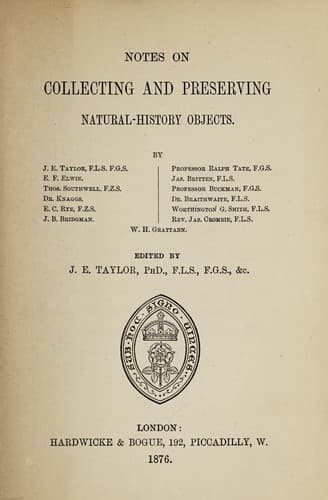
Notes on Collecting and Preserving Natural-History Objects
Science
Notes on Collecting and Preserving Natural-History Objects
Botanical specimens -- Collection and preservation; Zoological specimens -- Collection and preservation
A tin japanned vasculum, or what is perhaps better still, a black
leather haversack, of larger or smaller dimensions as the case may be,
suspended over the shoulder by a strap, is of course indispensable
for holding the specimens gathered. The latter of these we have found
to be more generally convenient, as we can take it with us also for a
short ramble, without its attracting so much attention from curious
rustics, as the less-known and more singular-looking vasculum. Two
sets of instruments are also necessary for removing the plant from
the substratum on which it grows, as well as for breaking off in
many cases a thin portion of the latter along therewith. These are a
geologist's hammer and chisel for such as grow on rocks, boulders, and
stones; a gardener's pruning-knife for such as grow on trees, pales,
and the ground; as also an ordinary table-knife for detaching, by
insertion under them, such foliaceous species as can thus be separated
from the substratum. To these must be added several sheets of soft
and moderately thick paper, cut into different sizes (some newspapers
suit remarkably well), in which to wrap up the individual specimens
and prevent them rubbing against each other; a few card-boxes also, of
various sizes, in which for greater safety to place any of the more
brittle species, or fragments of the rarer ones, by themselves; and
a pocket-lens of good magnifying power, by which we may be able to
detect on the spot those minuter species which the naked eye can with
difficulty distinguish. With these the lichenist is fully equipped for
an excursion, whether "near at hand or far away," and, with waterproof
and umbrella, is ready to take the field even in threatening weather. A
good deal of discrimination must be used in the selection of specimens
for removal, which, in all cases where such can be obtained, ought
to be fertile, with both apothecia and spermagones fully developed.
Hence, such as are too old or too young, may be passed by, as neither
the spores nor spermatia, by which alone, in many instances, they can
be determined, will be found in a normal condition, any more than the
thallus itself. The specimens gathered ought in every case to be of
sufficient size to show distinctly the character of the thallus and of
the fructification. Where, however, the thallus, as it frequently does,
spreads very extensively over the substratum, it will be sufficient to
break off such a portion from the circumference towards the centre, as
will give an adequate idea of the more important characteristics of
the plant. This is a point of considerable consequence; for should a
portion be taken off from the circumference alone, or from the centre
alone, it will often be entirely unsuitable for showing the real nature
of the plant, and be quite useless for purposes of description. A
little experience, however, will serve to prevent the commission of a
mistake, into which, judging from the number of imperfect specimens
Public-domain text, read in full here on John Shaqi.
Reviews
Reviews
No reviews yet
Be the first to share your thoughts on this work.
Elsewhere in the archive
Join the Discussion
Join the discussion
Sign in to leave a comment or review.
Sign InorCreate an account