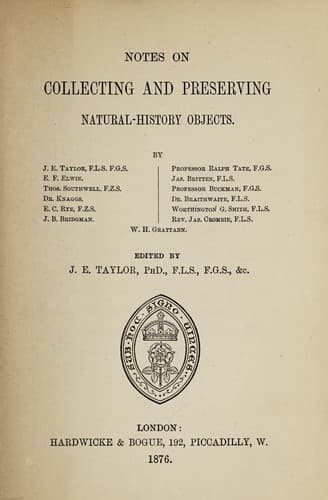
Notes on Collecting and Preserving Natural-History Objects
Science
Notes on Collecting and Preserving Natural-History Objects
Botanical specimens -- Collection and preservation; Zoological specimens -- Collection and preservation
which are sent me to be named, beginners are very apt to fall. Practice
will also in time enable the tyro to use the hammer and chisel in
such a way as to obtain neat specimens of saxicole species--a matter
of importance with respect to their subsequent mounting. As to the
best season for collecting, I need scarcely remind the reader that
lichens are perennial plants, remarkable for their longevity, and that
during the whole year round they may be found in fruit. The lichenist
has not to wait for any particular month or months, as other botanists
have to do, before he can collect the objects of his search in a
fully-developed condition. Spring, summer, autumn, and even winter,
except when the snow conceals all vegetation beneath its white mantle,
are all alike to him, and in each he will find every species of lichen
in perfection. At the same time, he will be most successful after a
shower of rain or a slight frost has fallen, inasmuch as, becoming
swollen with the moisture then imbibed, many of the minuter species
which might otherwise be overlooked, are more readily perceived, and
the foliaceous species more easily removed from the substratum to which
they are more or less closely affixed.
Nothing more need be said on the collecting of lichens, as a short
experience will be more useful than further details. We proceed,
therefore, to give a few hints on their subsequent preservation.
This is a very easy process, presenting no difficulty whatever, and
occupying but little time. We shall suppose that the collector has
returned from a successful expedition, with his vasculum or haversack
well filled with specimens from all sorts of habitats. Opening the
papers in which they have been wrapped up, he will take them out one by
one, and place them separately upon a table, over which a newspaper has
previously been spread. If gathered in wet weather, they ought not to
be left long in the papers, as in this case they are very apt to become
covered with mould. After allowing them to remain in this position till
they are thoroughly dry, he may at once proceed with hammer and chisel,
or with knife and scissors, to reduce to a suitable size such of them
as he could not conveniently thus manipulate in the field. When this is
done, they may then be affixed with gum, of a rather thick consistency,
to slips of white paper, with the locality and date of their collection
written beneath. There will be no difficulty felt in thus affixing
saxicole, corticole, and lignicole species, though where the nature of
the stone or wood is more absorbent, several applications of the gum
may be necessary before they properly adhere. With terricole species,
however, a somewhat more lengthened process is necessary, owing to
the brittle nature of the substratum, in consequence of which, if not
properly preserved, they often crumble into dust in the herbarium. To
prevent this, M. Norman, of Trömsoe, Norway, has recently prescribed a
Public-domain text, read in full here on John Shaqi.
Reviews
Reviews
No reviews yet
Be the first to share your thoughts on this work.
Elsewhere in the archive
Join the Discussion
Join the discussion
Sign in to leave a comment or review.
Sign InorCreate an account