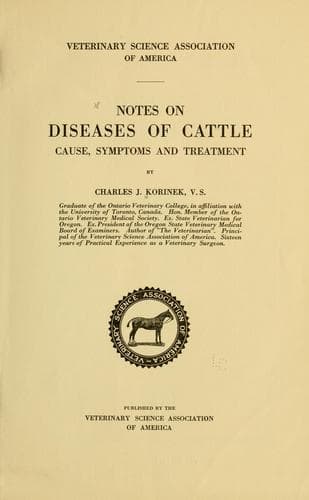
Notes on Diseases of Cattle: Cause, Symptoms and TreatmentKorinek, Charles James
Science
Notes on Diseases of Cattle: Cause, Symptoms and Treatment
Korinek, Charles James
Cattle -- Diseases
TREATMENT.—Prevention is the most important. Fields or pastures that are
infected with this disease should be burned every summer if possible, to
destroy the germs. The animals that succumb to the disease should be
buried deeply and quicklime thrown upon them, also any blood stains upon
the ground should have a strong disinfectant thrown upon them. The hide
of such an animal should not be used as the person removing it is likely
to contract the same disease, especially if an abrasion is present on
the hand, or such a hide or any portion thereof is likely to spread the
infection after reaching the tannery, etc.
MEDICAL TREATMENT OR SERUM TREATMENT.—This is the only thorough method
of eradicating the disease, and when this disease once becomes prevalent
in a locality all animals should be inoculated with vaccine.
BARRENNESS.
(_Failure to Breed_)
CAUSE.—Wasting or Atrophy, chronic inflammation of the mucous membrane
lining the organs of generation, Whites, absence or excessive secretions
of the organs of generation, contraction or displacement of the womb,
horns being telescoped or twisted, cysts or growths on the ovaries,
in-breeding or being a twin, are the predisposing causes of Barrenness.
TREATMENT.—Unsuccessful as a rule. Unless the cow is very valuable,
treatment is not advisable. A careful examination, however, is
recommended. If due to contraction of the neck of the womb it can be
readily dilated by the use of the hand, which should be greased with
Carbolated Sweet Oil before attempting to perform the operation.
BLACK LEG.
(_Symptomatic Anthrax—Black Quarter_)
CAUSE.—Due to germs. The Bacillus of Black Leg perhaps gains entrance to
the blood by wounds of the skin or the mucous membranes lining the mouth
and the intestines. This disease principally affects cattle, although
sheep and goats may become affected with the same disease.
SYMPTOMS.—This disease affects cattle that are in good condition between
the ages of six months and two years. In most cases death is very
sudden, and perhaps the animal is found dead. The first symptoms are
high temperatures from 104° to 108°F., loss of appetite, the animal
stops chewing the cud, breathing considerably hurried, the joints of the
limbs become swollen, also the chest and shoulders. All the swellings
are painful on pressure and spread very rapidly over the body. The
affected animals move with great difficulty and lie down frequently. If
the hand is passed over the body, there is a peculiar crackling sound
due to the gas developing under the skin. At the most distended portions
of the swellings the skin becomes dry and the animal apparently has no
sense of feeling. If the skin is punctured at this place, there will be
a dark red, frothy discharge which has a very disagreeable odor. There
will be a shivering of the muscles and the animal dies in convulsions.
Public-domain text, read in full here on John Shaqi.
Reviews
Reviews
No reviews yet
Be the first to share your thoughts on this work.
Join the Discussion
Join the discussion
Sign in to leave a comment or review.
Sign InorCreate an account