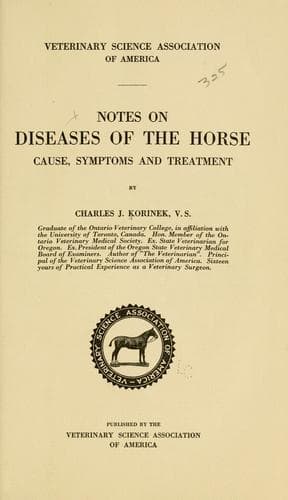
Notes on Diseases of the Horse: Cause, Symptoms and Treatment — John Shaqi
Notes on Diseases of the Horse: Cause, Symptoms and TreatmentKorinek, Charles James
Science
Notes on Diseases of the Horse: Cause, Symptoms and Treatment
Korinek, Charles James
Horses -- Diseases
TREATMENT.—Almost every medicine in the pharmacopoeia has been tried in
the treatment of tetanus, certain remedies meeting with great success
in the hands of some practitioners, and proving total failures in the
hands of others. It is, however, generally admitted by the members of
the profession that perfect quietness is of greatest importance in the
treatment of tetanus. Place the patient in a dry, well ventilated,
loose box stall, slightly darkened, if possible, in an out-of-the-way
place, and fill the ears with cotton-wool. Administer a full dose of
purgative medicine (aloes eight drams) and follow with belladonna in a
capsule or bolus. The body should be lightly clothed, and the animal
placed in slings. Never give drench if it produces excitement. When the
wound can be discovered, powerful antiseptics should be continually
applied to its lowest depths. Arsenious acid, chloroform, hyoscyamus,
digitalis, belladonna, chloral hydrate, morphine, potassium bromide,
carbolic acid, and many other medicines have been used, and some of
them have been found beneficial. Belladonna is probably as good as any,
and should be given freely. Inhalations of chloroform temporarily abate
spasm, but the reaction afterwards is usually severe. Medicines which
can be given in the drinking-water may be administered in that way. The
food should consist of milk, eggs, beef-tea, wine gruel, and food of
that description, easily taken and of a very nutritious character. Too
great care or attention cannot possibly be bestowed upon the animal.
The after-treatment consists of allowing a liberal quantity of good
nutritious food—green food is preferable. Exercise daily for some time
after recovery has taken place, and the work should be light and slow for
a month or two.
PREVENTIVE TREATMENT.—An antitoxin serum, if injected under the skin
of a patient before a surgical operation, or immediately after the
infection of a wound, is a most reliable safeguard against tetanus. It
should always be used in districts where tetanus is prevalent. Its value
subcutaneously is solely preventive, not curative; and it is of no use
when once the disease has gained a foothold.
LUNG FEVER.
(_Pneumonia_)
CAUSE.—Predisposition is largely accountable for this disease, which
is more common to young horses than old; also, changes of temperature,
introduction of foreign bodies or liquids into the trachea (windpipe) and
the bronchial tubes, inhalation of smoke or irritating gases, excitement,
exposure to cold after clipping, turning out to pasture from a warm
stable, or injury to chest or ribs from being struck with a pole, etc.
Public-domain text, read in full here on John Shaqi.
Reviews
Reviews
No reviews yet
Be the first to share your thoughts on this work.
Join the Discussion
Join the discussion
Sign in to leave a comment or review.
Sign InorCreate an account