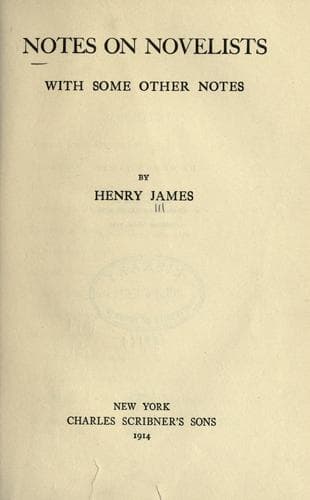
Notes on Novelists, with Some Other NotesJames, Henry
History
Notes on Novelists, with Some Other Notes
James, Henry
Fiction -- History and criticism; Novelists
Balzac on the other hand, born as we have seen to confidence, the tonic
air of his paradise, might make character, in the sense in which we use
it, that of the element exposable to the closest verification, sit or
stand for its “likeness” as still as ever it would. It is true that he
could, as he often did, resort to fond extravagance, since he was apt at
his worst to plunge into agitation for mere agitation’s sake—which is a
course that, by any turn, may cast the plunger on the barrenest strand.
But he is at his best when the conditions, the whole complex of
subdivisible form and pressure, are virtually themselves the situation,
the action and the interest, or in other words when these things exhaust
themselves, as it were, in expressing the persons we are concerned with,
agents and victims alike, and when by such vivified figures, whether
victims or agents, they are themselves completely expressed. The three
distinguished critics who have best studied him, Taine, Brunetière and
now (as well as before this) M. Faguet—the first the most eloquent but
the loosest, and the last the closest even if the dryest—are in
agreement indeed as to the vast quantity of waste in him, inevitably
judging the romanticist as whom he so frequently, speculatively,
desperately paraded altogether inferior to the realist whose function he
could still repeatedly and richly and for his greater glory exercise.
This estimate of his particularly greater glory is of a truth not wholly
shared by M. Taine; but the three are virtually at one, where we of
course join them, or rather go further than they, as to the enviability,
so again to call it (and by which we mean the matchless freedom of
play), of his harvesting sense when he gave himself up in fullest
measure to his apprehension of the dense wholeness of reality. It was
this that led him on and kept him true to that happily largest side of
his labour by which he must massively live; just as it is this, the
breath of his real geniality, when every abatement is made, that stirs
to loyalty those who under his example also take his direction and find
their joy in watching him thoroughly at work. We see then how, when
social character and evolved type are the prize to be grasped, the facts
of observation and certification, unrestingly social and historic too,
that form and fondle and retouch it, never relaxing their action, are so
easily and blessedly absolute to him that this is what we mean by their
virtue.
Public-domain text, read in full here on John Shaqi.
Reviews
Reviews
No reviews yet
Be the first to share your thoughts on this work.
Elsewhere in the archive
Join the Discussion
Join the discussion
Sign in to leave a comment or review.
Sign InorCreate an account