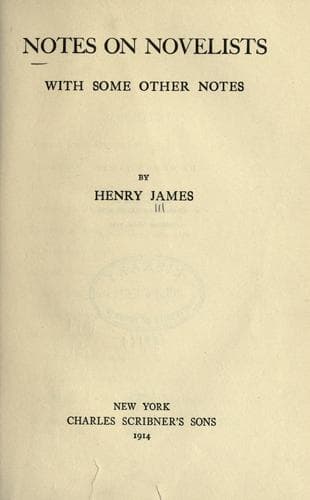
Notes on Novelists, with Some Other NotesJames, Henry
History
Notes on Novelists, with Some Other Notes
James, Henry
Fiction -- History and criticism; Novelists
So it was then that his huge felicity, to re-emphasise our term, was in
his state of circulating where recognitions and identifications didn’t
so much await as rejoicingly assault him, having never yet in all the
world, grudged or at the best suspected feeders as they were at the
board where sentiment occupied the head, felt themselves so finely
important or subject to such a worried intention. They hung over a scene
as to which it was one of the forces of his inspiration that history had
lately been there at work, with incomparable energy and inimitable art,
to pile one upon another, not to say squeeze and dovetail violently into
each other, after such a fashion as might defy competition anywhere, her
successive deposits and layers of form and order, her restless
determinations of appearance—so like those of the different “states” of
an engraver’s impression; all to an effect which _should_ have
constituted, as by a miracle of coincidence it did, the paradise of an
extraordinary observer. Balzac lived accordingly, extraordinary since he
was, in an earthly heaven so near perfect for his kind of vision that he
could have come at no moment more conceivably blest to him. The later
part of the eighteenth century, with the Revolution, the Empire and the
Restoration, had inimitably conspired together to scatter abroad their
separate marks and stigmas, their separate trails of character and
physiognomic hits—for which advantage he might have arrived too late,
as his hapless successors, even his more or less direct imitators,
visibly have done. The fatal fusions and uniformities inflicted on our
newer generations, the running together of all the differences of form
and tone, the ruinous liquefying wash of the great industrial brush over
the old conditions of contrast and colour, doubtless still have left the
painter of manners much to do, but have ground him down to the sad fact
that his ideals of differentiation, those inherent oppositions from type
to type, in which drama most naturally resides, have well-nigh perished.
They pant for life in a hostile air; and we may surely say that their
last successful struggle, their last bright resistance to eclipse among
ourselves, was in their feverish dance to the great fiddling of Dickens.
Dickens made them dance, we seem to see, caper and kick their heels,
wave their arms, and above all agitate their features, for the simple
reason that he couldn’t make them stand or sit _at once_ quietly and
expressively, couldn’t make them look straight out as for
themselves—quite in fact as through his not daring to, not feeling he
could afford to, in a changing hour when ambiguities and the wavering
line, droll and “dodgy” dazzlements and the possibly undetected
factitious alone, might be trusted to keep him right with an incredibly
uncritical public, a public blind to the difference between a shade and
a patch.
Public-domain text, read in full here on John Shaqi.
Reviews
Reviews
No reviews yet
Be the first to share your thoughts on this work.
Elsewhere in the archive
Join the Discussion
Join the discussion
Sign in to leave a comment or review.
Sign InorCreate an account