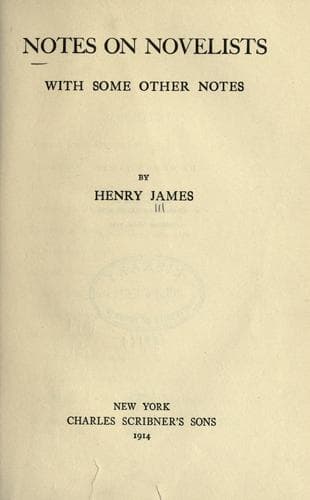
Notes on Novelists, with Some Other NotesJames, Henry
History
Notes on Novelists, with Some Other Notes
James, Henry
Fiction -- History and criticism; Novelists
This illustration gains logically, much more than loses, from the rank
predominance of the money-question, the money-vision, throughout all
Balzac. There are lights in which it can scarce not appear to us that
his own interest is greater, his possibilities of attention truer, in
these pressing particulars than in all other questions put together;
there could be no better sign of the appreciation of “things,” exactly,
than so never relaxed a grasp of the part played in the world by just
these. Things for things, the franc, the shilling, the dollar, are the
very most underlying and conditioning, even dramatically, even
poetically, that call upon him; and we have everywhere to recognise how
little he feels himself to be telling us of this, that and the other
person unless he has first given us full information, with every detail,
either as to their private means, their income, investments, savings,
losses, the state in fine of their pockets, or as to their immediate
place of habitation, their home, their outermost shell, with its windows
and doors, its outside appearance and inside plan, its rooms and
furniture and arrangements, its altogether intimate facts, down to its
very smell. This prompt and earnest evocation of the shell and its
lining is but another way of testifying with due emphasis to economic
conditions. The most personal shell of all, the significant dress of the
individual, whether man or woman, is subject to as sharp and as deep a
notation—it being no small part of his wealth of luck that the age of
dress differentiated and specialised from class to class and character
to character, not least moreover among men, could still give him
opportunities of choice, still help him to define and intensify, or
peculiarly to _place_ his apparitions. The old world in which costume
had, to the last refinement of variety, a social meaning happily
lingered on for him; and nothing is more interesting, nothing goes
further in this sense of the way the social concrete could minister to
him, than the fact that “César Birotteau,” to instance that masterpiece
again, besides being a money-drama of the closest texture, the very epic
of retail bankruptcy, is at the same time the all-vividest exhibition of
the habited and figured, the representatively stamped and countenanced,
buttoned and buckled state of the persons moving through it. No livelier
example therefore can we name of the triumphant way in which any given,
or as we should rather say taken, total of conditions works out under
our author’s hand for accentuation of type. The story of poor Birotteau
is just in this supreme degree a hard total, even if every one’s
money-relation does loom larger, for his or her case, than anything
else.
Public-domain text, read in full here on John Shaqi.
Reviews
Reviews
No reviews yet
Be the first to share your thoughts on this work.
Elsewhere in the archive
Join the Discussion
Join the discussion
Sign in to leave a comment or review.
Sign InorCreate an account